By Broker Carla | Real Estate Tips
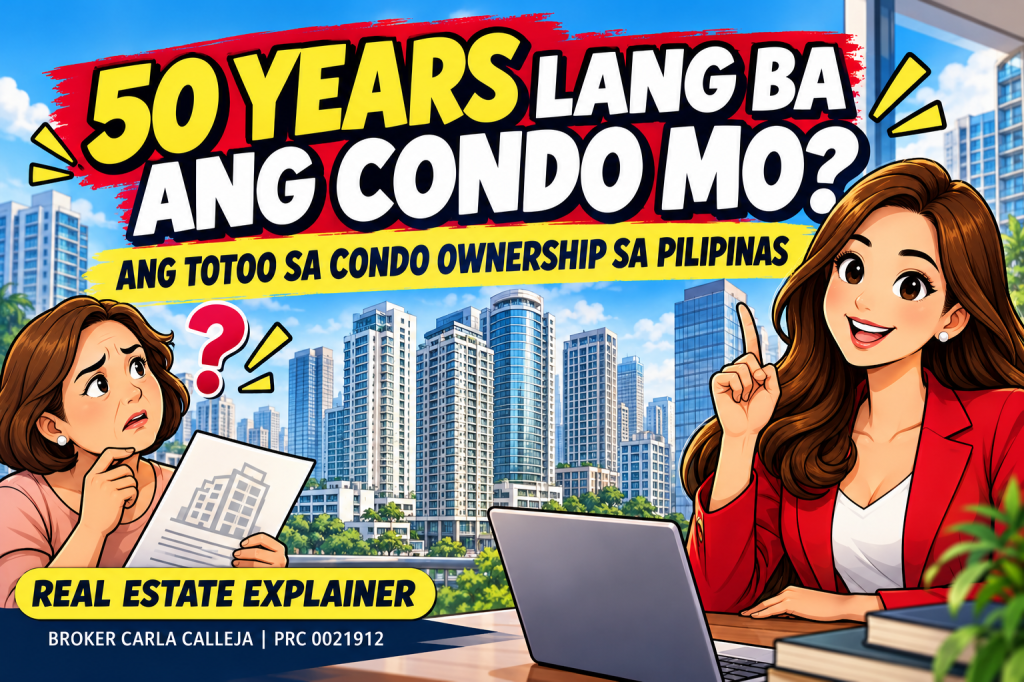
“Broker Carla, sayang ba ang condo ko?”
Tita Linda (not her real name) called me one Sunday afternoon, almost in tears.
She and her late husband bought a 2-bedroom unit in a Makati building in the late 1970s. They raised their kids there and paid off every centavo. Now she wanted to leave it to her two children.
At a family lunch, a relative told her: “Tita, wala na ‘yan. 50 years lang ang condo. Pag lampas na, babalik ‘yan sa developer o gigibain.”
She didn’t sleep that night. “Broker Carla, totoo ba? Nawala na ba ang bahay namin?”
I asked her to bring out her Condominium Certificate of Title (CCT), her tax declarations and the building’s Master Deed. Then I told her what I’m telling you now.
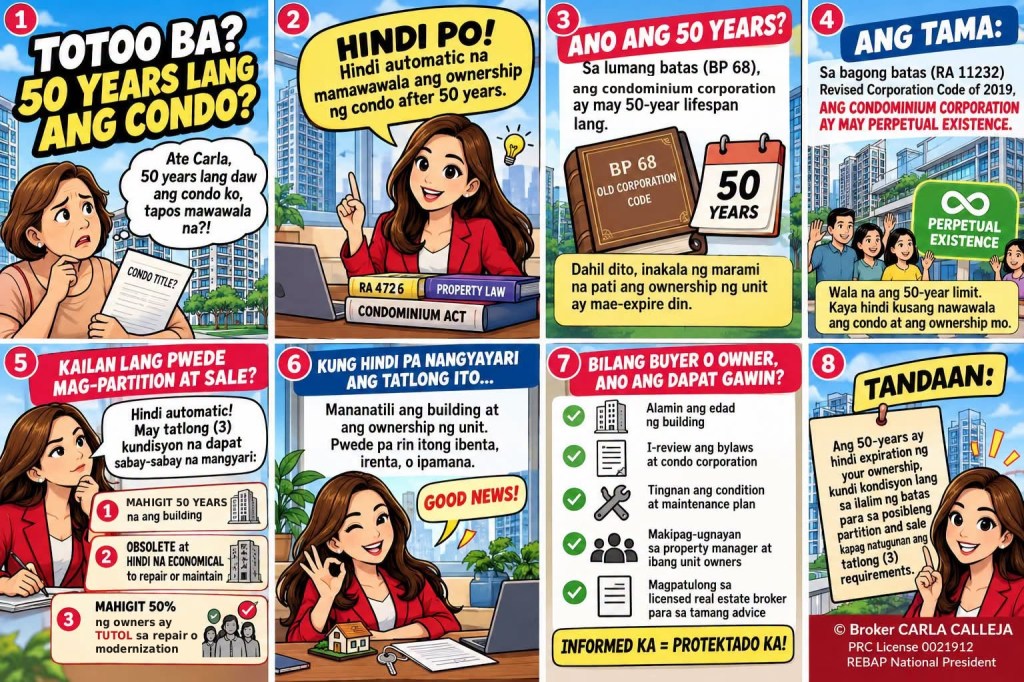
Hindi po. Your ownership did not expire.
Where the “50 years” myth came from
The confusion comes from two different laws that people mix up.
1. The old Corporation Code (BP 68). Under the old law, corporations could exist for a maximum of 50 years, renewable. Because every condo project has a condominium corporation that manages the common areas, many assumed the building, and therefore their unit, had a 50-year lifespan too.
2. The Revised Corporation Code (RA 11232, 2019). This has changed. Corporations now have perpetual existence unless their articles of incorporation say otherwise, and existing corporations are generally deemed perpetual as well.
The Condominium Act (RA 4726) itself also provides that a condominium corporation’s term is coterminous with the condominium project, regardless of the general corporation law.
And here’s the key point: the condominium corporation is not the same as your ownership of the unit. Your unit is covered by your own CCT, registered in your name.
So what does the 50-year rule actually say?
Section 8 of RA 4726 lists limited situations when owners may go to court to have the entire project partitioned by sale. One of them applies only when all three conditions are present:
- The project has existed for more than 50 years;
- It is obsolete and uneconomic; and
- Owners holding more than 50% interest in the common areas are opposed to repairing, restoring, remodeling or modernizing it.
Even then, it is not a confiscation. A partition by sale means the property is sold and owners receive their share of the proceeds according to their interest. Section 8 also covers other situations, such as major damage, destruction or expropriation. None of them is an automatic “expiration.”
In short, 50 years is a condition, not a deadline.
What happened to Tita Linda?
Her building is well past 40 years old. But it has an active association, updated by-laws and a regular maintenance plan. Owners recently voted to repaint the façade and upgrade the elevators.
Obsolete and uneconomic? No. Majority opposed to repairs? Definitely not.
Her unit is still hers, still sellable, still rentable and still inheritable. We’re now preparing the proper documents so the transfer to her children goes smoothly.
What cost her a sleepless night was a rumor, not the law.
What should you do as a condo owner or buyer?
- Know the building’s age and history. Ask when the project was completed and what major repairs have been done.
- Read the Master Deed, Declaration of Restrictions and By-Laws. The Declaration may contain its own conditions for partition.
- Check the building’s condition and maintenance plan. A well-maintained building protects your property’s value.
- Attend association meetings and vote. The 50-year rule depends on what the owners decide.
- Keep your documents in order. That means your CCT, tax declarations, and association dues clearances.
- Consult a licensed real estate broker, and a lawyer for legal disputes, before buying, selling or settling an estate.
The bottom line
Your condo does not come with an expiration date. Under Philippine law, ownership of your unit continues. The 50-year provision applies only when the building is old, obsolete and uneconomic, and the majority of owners refuse to fix it.
Huwag basta maniwala sa sabi-sabi. Informed ka, protektado ka.
Have questions about your condo, an inherited unit, or a building you’re eyeing? Message me through this website or email info@carlacalleja.com.
References
- Republic Act No. 4726, The Condominium Act (1966), particularly Sections 8 and 10, as amended by Republic Act No. 7899 (1995). Full text on Lawphil
- Republic Act No. 11232, Revised Corporation Code of the Philippines (2019), Section 11 (Corporate Term). Full text on Lawphil
- Batas Pambansa Blg. 68, Corporation Code of the Philippines (1980), Section 11 (now repealed). Full text on Lawphil
Disclaimer: This article is for general information only and is not legal advice. For specific cases, consult a lawyer.
ⓒ Broker CARLA CALLEJA
PRC License 0021912
DHSUD Accred. No. 0024330


