
By Carla Calleja, MBA, REB
Guess the year
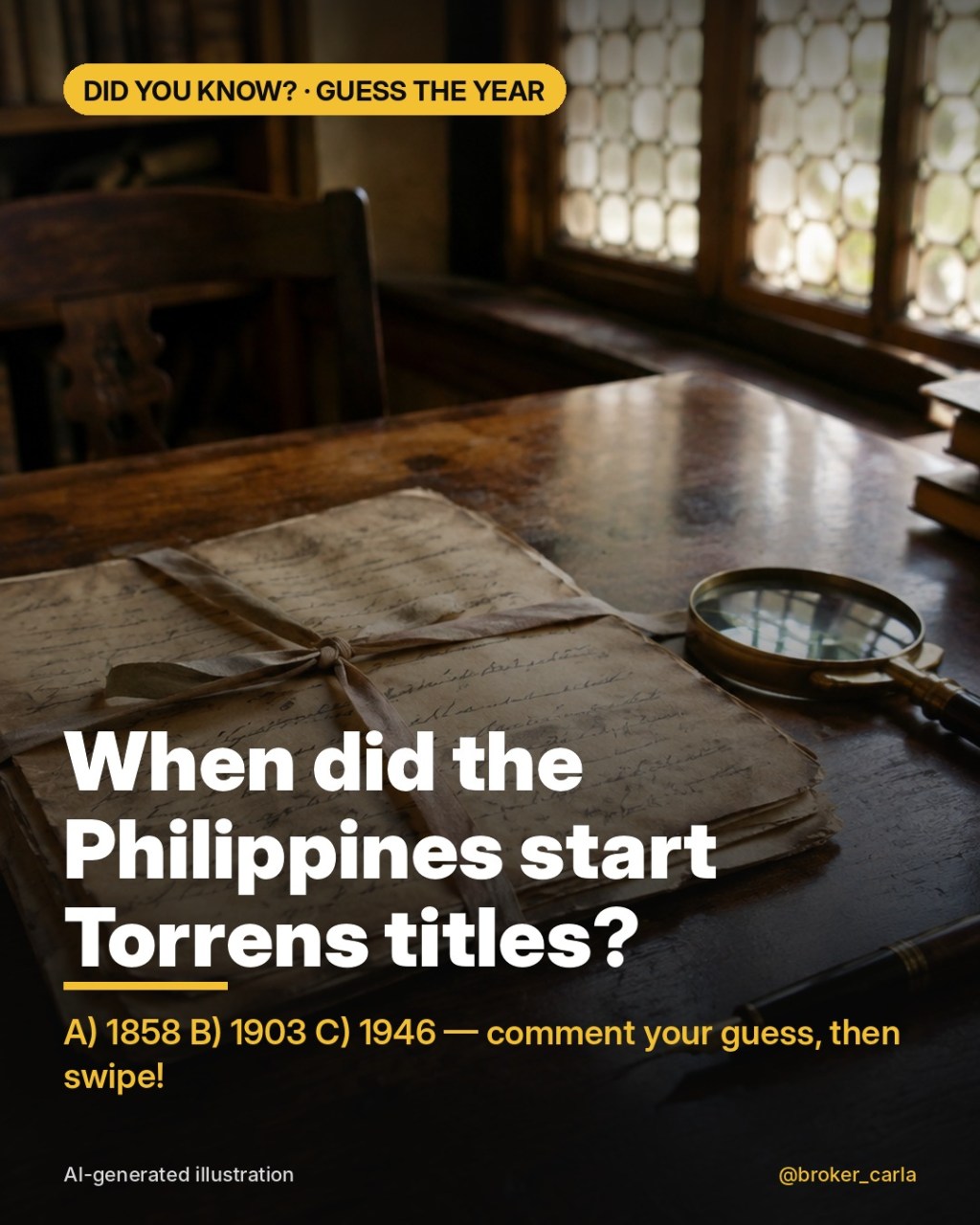
When did the Philippines start issuing Torrens titles? Was it A) 1858, B) 1903, or C) 1946? Many people guess 1946, the year of independence. The answer is B) 1903.
The short answer
Our Torrens system began with Act No. 496, the Land Registration Act, enacted on November 6, 1902. Its original effectivity date was January 1, 1903, but Act No. 572 moved it to February 1, 1903. Act 496 created the Court of Land Registration and the Registers of Deeds, the foundation of the land titles we use today. Records I could verify do not reliably identify who received Original Certificate of Title No. 1, so I will not guess here.
And 1858? That is when Robert Torrens’ system began in South Australia under its Real Property Act, the model that gave the Torrens title its name.
Before Torrens: Spanish-era titles
During Spanish rule, land ownership was proven by several kinds of documents:
- Título real – a royal grant of land.
- Composición con el estado – an adjustment title, issued after a settlement with the State.
- Título de compra – a title by purchase.
- Información posesoria – a possessory information title under the Spanish Mortgage Law. It was only prima facie proof of possession, which could ripen into a record of ownership after 20 years of uninterrupted possession.
Myth vs fact: Is a Spanish title still valid proof of ownership?
Myth: “We have a título real from our ancestors, so the land is ours.” Fact: Presidential Decree No. 892, dated February 16, 1976, gave holders of Spanish titles six months to apply for registration under Act 496. After that period, Spanish titles can no longer be used as evidence of land ownership in any land registration proceedings under the Torrens system. The Supreme Court has applied P.D. 892 in later cases, including San Pedro v. Court of Appeals, G.R. No. 103727 (Dec. 18, 1996).
Bonus: among the oldest known land documents
Two land deeds of sale written in baybayin, dated February 15, 1613 (land in Tondo) and December 4, 1625 (land in Mayhaligue, now part of Santa Cruz, Manila), are kept at the University of Santo Tomas Archives. The National Archives declared them National Cultural Treasures in 2014. They are deeds of sale, not titles, but they show how long Filipinos have been documenting land ownership.
How the land registration agency evolved
From the Court of Land Registration under Act 496, land registration passed to the General Land Registration Office, then the Land Registration Commission (R.A. 1151, 1954), then the National Land Titles and Deeds Registration Administration (E.O. 649, 1981), and finally today’s Land Registration Authority under the 1987 Administrative Code.
What this means for you
- If your family still relies on a Spanish-era document, it will not prove ownership by itself in land registration today. Talk to a lawyer about the available routes, such as judicial confirmation of title.
- Before buying land, ask for a certified true copy of the title from the Registry of Deeds, not just old papers or tax declarations.
- Old documents still have value as history and as supporting evidence of possession. Keep them safe.
FAQ
Who got OCT No. 1 in the Philippines?
I could not find a reliable official source that identifies the first Original Certificate of Title, so I am not naming one. If you have an LRA source, send it to me.
What is an OCT vs a TCT?
An Original Certificate of Title (OCT) is the first title issued when land is registered for the first time. A Transfer Certificate of Title (TCT) is issued each time the registered land is transferred to a new owner.
Is a tax declaration a title?
No. A tax declaration is for real property tax purposes and is only an indication of a claim of ownership. Read my companion article on how to get land titled when you only have a tax declaration.
Ask Broker Carla
Got an old title or a land question? Send me your “Broker Carla, …” question in the comments, on facebook.com/carlacallejabrokerphilippines, or at buyrentph@gmail.com.
Featured image: AI-generated illustration.
Sources
- Land Registration Authority: History
- Act No. 572 (effectivity of Act 496)
- P.D. No. 892 (Lawphil)
- San Pedro v. Court of Appeals, G.R. No. 103727
- Philippine Law Journal: Spanish land titles
- UST: The Baybayin Documents
- The Varsitarian: Baybayin is UST’s 5th National Cultural Treasure
- SA History Hub: Torrens title

