By Carla Calleja, MBA, REB
A question I get a lot, especially every rainy season: “Broker Carla, our house keeps getting flooded but the developer said it’s flood-free. Can I demand a refund and return the property?”
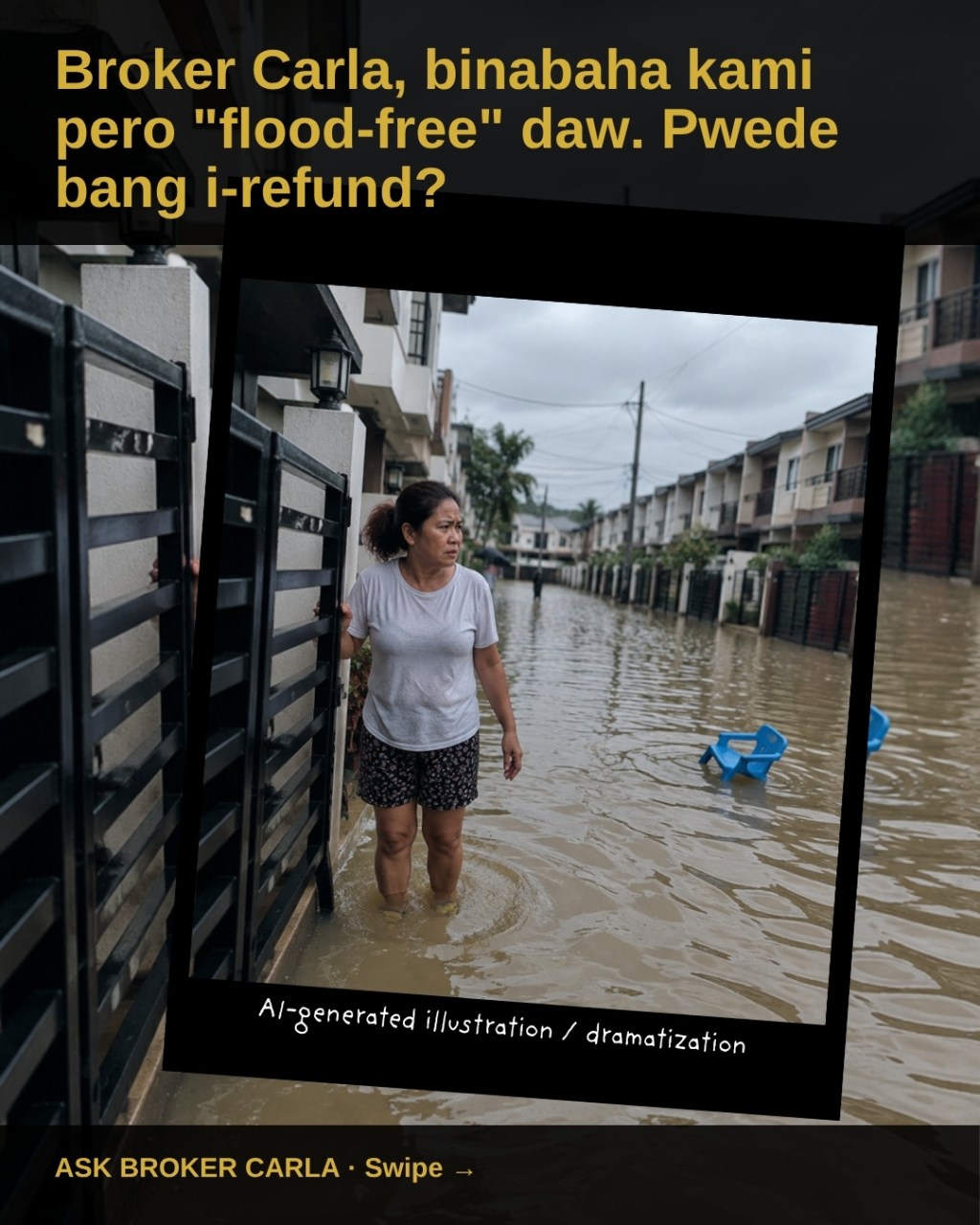
The story (a dramatization)
Aling Rosa (not her real name) bought a townhouse in a subdivision. The brochure and the agent both said the same thing: “flood-free.” She paid her down payment and started her monthly amortization. Then came the first big monsoon. Knee-deep brown water entered her living room. The next typhoon, the same. Her appliances are damaged, her bank says the unit may be hard to refinance, and she wants out. Can she return the house and get her money back?
The short answer
Possibly, but it is not automatic. The law treats a developer’s advertisements as real promises, and it gives buyers remedies such as refunds, repairs or damages. The catch is proof: you must show what was promised, that the promise was false, and that the flooding is the developer’s responsibility, not only the weather or something outside the project.
What the law says
1. PD 957, Section 19: ads must tell the truth
Under the Subdivision and Condominium Buyers’ Protective Decree (PD 957), advertisements by an owner or developer “must reflect the real facts and must be presented in such manner that will not tend to mislead or deceive the public.” Facilities, improvements and other developments promised in brochures and sales materials are treated as sales warranties that can be enforced against the owner or developer. A written “flood-free” claim in a brochure is strong evidence.
2. PD 957, Section 23: no forfeiture when the developer fails to develop
If a buyer stops paying because the developer failed to develop the project according to the approved plans and within the time limit, the installments already paid cannot be forfeited. After due notice, the buyer may ask for reimbursement of the total amount paid, including amortization interest but excluding delinquency interest, with interest at the legal rate. This applies when the problem is a failure to develop according to approved plans, for example missing or substandard drainage that was part of the plan.
3. Civil Code: fraud and hidden defects
- Fraud (Arts. 1390 and 1391): a contract where consent was obtained through fraud is voidable. The action to annul must be filed within four years from discovery of the fraud.
- Hidden defects (Art. 1561 and following): the seller warrants the property against hidden defects that make it unfit for its use. Depending on the case, the buyer may withdraw from the sale or ask for a price reduction, with damages in some cases. The deadline is short: six months from delivery (Art. 1571).
4. Where to file
Complaints by subdivision and condominium buyers against developers are handled by the Human Settlements Adjudication Commission (HSAC), which took over the adjudication functions of the former HLURB when the Department of Human Settlements and Urban Development (DHSUD) was created under RA 11201.
The twist: what the Supreme Court said
In Filinvest Land, Inc. v. Flood-Affected Homeowners of Meritville Alliance, G.R. No. 165955, August 10, 2007 (First Division, Sandoval-Gutierrez, J.), 54 homeowners in a Las Piñas townhouse subdivision complained of recurring floods. They won before the HLURB arbiter, which ordered relief including suspension of amortizations, elevation or relocation, and damages. The HLURB Board, the Office of the President and the Court of Appeals all upheld them.
The Supreme Court reversed. It found that the subdivision was the first in the area and did not flood at first. Later developments around it raised the surrounding land, so the subdivision became a catch basin, and the heavily silted Naga River could not carry the water. The developer had even installed a pumping station and improved drainage. The Court held that “negligence is never presumed but must be proven by whoever alleges it,” and that flood control in the area was the duty of the city government under Section 17 of the Local Government Code.
Note: that decision turned on negligence and causation. It did not rule on a written “flood-free” advertisement. That is why evidence of what was promised, and of what actually causes the flooding, matters so much.
Step by step: what to do
- Collect the promise. Brochures, flyers, screenshots of ads and social media posts, chats or emails with the agent, and the model house materials that say “flood-free.”
- Document every flood. Dated photos and videos, water height, damaged items and repair receipts.
- Get outside records. Barangay or city flood records and, if available, hazard maps for the area. Ask whether nearby projects or roads raised the ground level.
- Check the approved plans. Ask the developer or DHSUD for the approved subdivision plan and the drainage design.
- Send a written demand to the developer, preferably through a lawyer, stating the problem and what you want: repair, refund or replacement.
- File with DHSUD’s HSAC if the developer does not act. Watch the deadlines, especially the six-month limit for hidden-defect claims.
Costs
Expect filing fees, lawyer’s fees, and possibly a hydrologist’s or engineer’s report to prove the cause of flooding. Fees vary by claim and provider, so ask HSAC and your lawyer for current amounts before you file.
What this means for you
- Keep the ads and brochures. Under PD 957 they can be part of your deal.
- Flooding alone is not proof of fault. Show what causes it.
- Act early. Some claims have short deadlines.
- Before buying, check hazard maps, ask neighbors, and visit during the rainy season. A licensed broker should help you do this.
FAQ
Can I just stop paying my amortization?
Section 23 of PD 957 protects buyers who stop paying because the developer failed to develop the project per approved plans, but you must give due notice. Do this with a lawyer’s guidance so it is not treated as an ordinary default.
The agent said “flood-free” but the brochure did not. Does it count?
Verbal claims are harder to prove. Look for messages, posts or witnesses. Written materials are much stronger evidence.
Where do I file a complaint against a developer?
With the Human Settlements Adjudication Commission (HSAC) under DHSUD.
What if the flooding is caused by new projects around us?
That was the situation in the Meritville case, where the Supreme Court said the developer was not negligent and pointed to the city’s duty on flood control. Bring this to your LGU as well.
Ask Broker Carla
May tanong ka rin? Comment FLOOD or ASK on my posts, send your “Broker Carla, …” question to facebook.com/carlacallejabrokerphilippines, or email buyrentph@gmail.com.
The story above is a dramatization with fictional names. Images are AI-generated illustrations.
This article is for general information only and is not legal or tax advice. For your specific situation, consult a lawyer or a licensed professional.
Sources
- Filinvest Land, Inc. v. Flood-Affected Homeowners of Meritville Alliance, G.R. No. 165955, Aug. 10, 2007 (LawPhil)
- Presidential Decree No. 957 (LawPhil)
- Civil Code Arts. 1390 to 1402, voidable contracts (Batas Natin)
- RA 11201, DHSUD replaces HLURB (Batas Natin)
- Daily Tribune: PD 957, HSAC has jurisdiction over civil liability

