
By Carla Calleja, MBA, REB
This Undas, many families will visit Lola and Lolo at the cemetery, then go home and talk about the same thing: the land is still in Lola’s name. The title was never transferred because nobody paid the estate tax. Now the penalties feel bigger than the property. If that sounds like your family, here is news worth reading.
The short answer
There is no estate tax amnesty in force right now. The last one expired on June 14, 2025. But on October 23, 2026, the Senate Committee on Ways and Means heard the bills that would bring it back, including Senate Bill No. 1889 filed by Sen. Panfilo Lacson. The bill is still at the committee stage. It is not law yet.
What happened at the Senate hearing
- Who is covered: SB 1889 covers estates of people who died on or before December 31, 2025.
- The rate: a uniform 6% of the net estate. Senate President Sherwin Gatchalian asked the Department of Finance (DOF) to study whether 6% is still too high for poor families with small rural lots.
- The House version: the House bill extending the previous amnesty was transmitted to the Senate on December 17, 2025.
- Deadline talk: the DOF proposed that the availment period end on June 30, 2028. Sen. Lacson pushed for filing with payment, so families do not file and then sit on it.
- Pending cases: the DOF supported letting estates with pending tax cases avail of the amnesty.
- Documents: senators questioned accepting barangay certifications in place of PSA death certificates. Expect stricter proof of death.
Who is affected
- Heirs whose land, house or condo is still titled in a deceased parent’s or grandparent’s name.
- OFWs who inherited property back home and cannot sell or mortgage it.
- Families who want to partition inherited property so each heir gets a separate title.
- Buyers of inherited property. Without the estate tax paid, the BIR will not issue the eCAR, and the Registry of Deeds will not issue a new title in your name.
Why this matters
Under the National Internal Revenue Code as amended by the TRAIN Law (RA 10963), the regular estate tax is already 6% of the net estate. So why do families wait for an amnesty? Because many estates are years or decades late, and the surcharges and interest for late payment pile up on top of the basic tax. An amnesty is meant to give families a cleaner way to settle old estates so properties can finally be transferred, sold or used as collateral.
What to do now, step by step
- Do not wait for the law to pass to get organized. Paperwork takes months, especially for older estates.
- Get the PSA death certificate of the deceased. Senators signaled that proof of death will be checked closely.
- Collect the property papers: certified true copy of the title from the Registry of Deeds, latest tax declaration and real property tax receipts from the assessor and treasurer.
- List all the heirs and gather their IDs and birth or marriage certificates. Every heir matters (see our Ask Broker Carla article on heirs’ shares).
- Check the values: the BIR zonal value and the assessor’s fair market value, because the tax is computed on the higher value.
- Talk as a family. Agree on who will process, who will pay, and whether you will keep, partition or sell.
What this means for you
- No amnesty is available today; regular estate tax rules apply until a new law is signed.
- If you are buying from heirs, ask for proof that the estate tax was paid and the eCAR was issued before you pay in full.
- Follow the bill. I will post here as soon as it moves in the Senate.
FAQ
Can I still avail of the estate tax amnesty today?
No. The last amnesty expired on June 14, 2025. A new one needs a law passed by Congress and signed by the President.
If Lola died in 2025, would she be covered?
Under SB 1889 as filed, yes: it covers deaths on or before December 31, 2025. The final law may still change this cut-off.
Can we sell the property before the estate tax is paid?
Heirs can agree to sell, but the title cannot be transferred to the buyer without settling the estate and the estate tax first. Many sales are structured so the estate tax is paid from the buyer’s payment. Get professional help to do this safely.
Is the regular estate tax also 6%?
Yes. Since the TRAIN Law, the regular estate tax rate is 6% of the net estate. The difference with an amnesty is how it treats late filings, surcharges and interest.
Ask Broker Carla
Is your family’s property still in Lola’s name? Send me your “Broker Carla, …” question. Comment on my Facebook page at facebook.com/carlacallejabrokerphilippines or email buyrentph@gmail.com.
This article is for general information only and is not legal or tax advice. For your specific situation, consult a lawyer or a licensed professional.
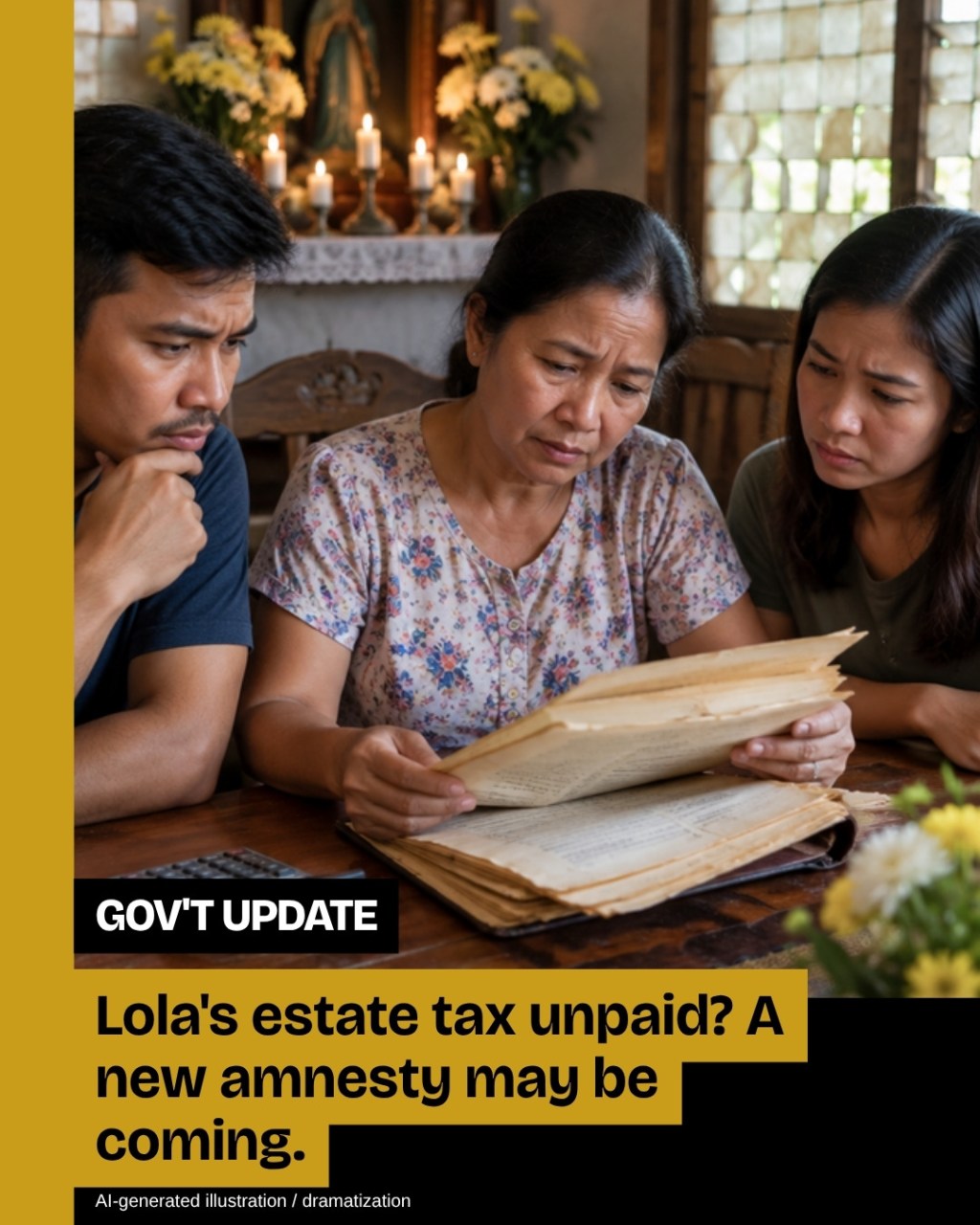
Cover image: AI-generated illustration / dramatization.
Sources
- Office of Sen. Panfilo Lacson: Lacson pushes balance between taxpayer relief, government revenues in estate tax amnesty measure (Oct. 23, 2026)
- Atin Ito: Tighter estate tax amnesty bill pushed in Senate (Oct. 24, 2026)
- DZRH: Lacson highlights estate tax amnesty’s role in easing tax payments for heirs (Oct. 23, 2026)
- SunStar: the previous amnesty extension to June 14, 2025

