
By Carla Calleja, MBA, REB
The story
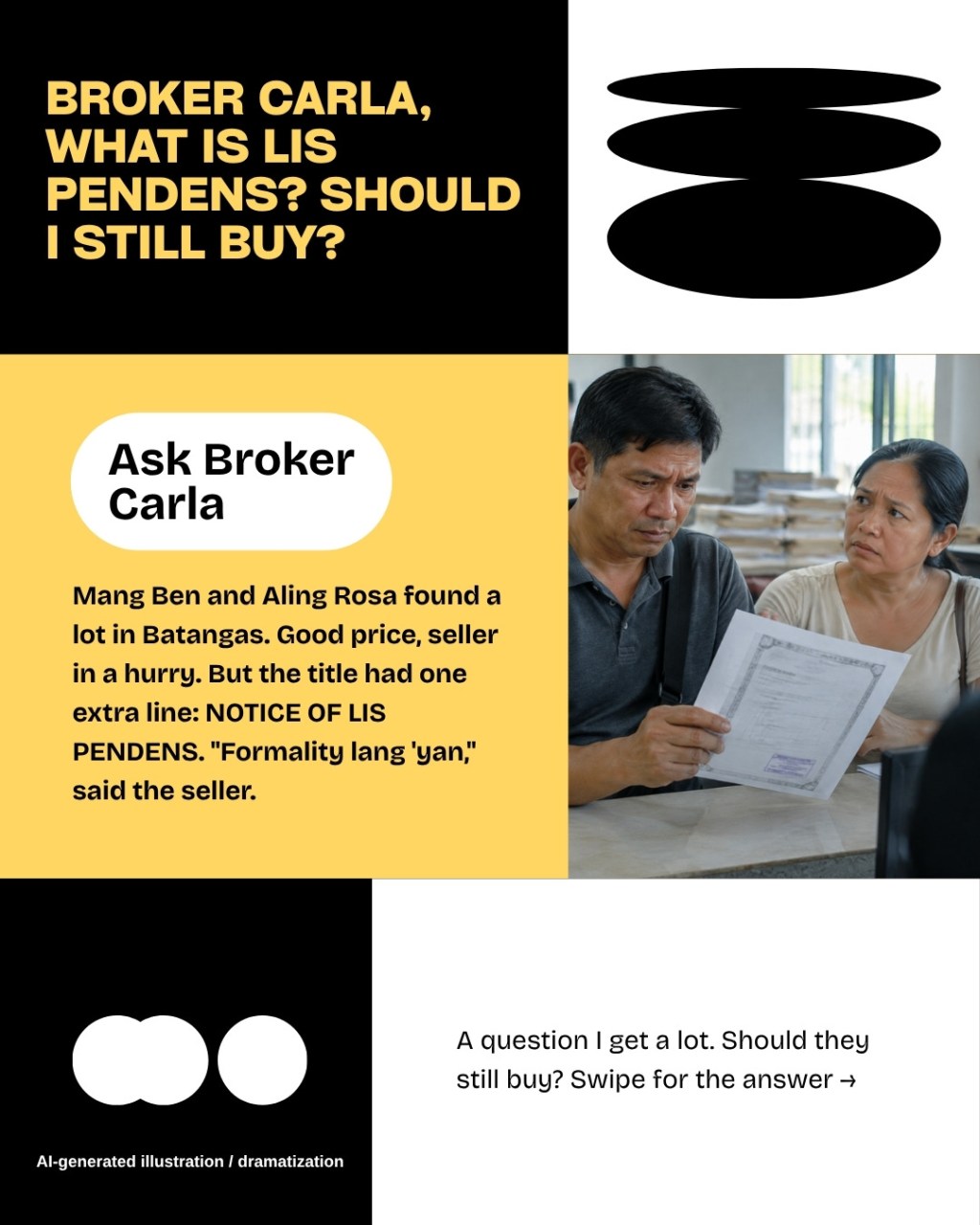
Isa sa pinakamadalas itanong sa akin: “Broker Carla, what is Lis Pendens? Should I still buy?”
Picture Mang Ben and Aling Rosa (not their real names; this is a dramatization). They found a lot in Batangas. Good price, and the seller was in a hurry. They did the smart thing and got a certified true copy of the title from the Registry of Deeds. At the bottom of the title was one extra line: NOTICE OF LIS PENDENS.
The seller waved it off: “Formality lang ‘yan. Bibigyan ko na lang kayo ng discount.” Should they still buy?
The short answer
A notice of lis pendens means there is a pending court case that affects the title or possession of the property. It does not decide who is right, but it warns everyone who deals with the property. If you buy while the notice is there, you buy at your own risk and you are bound by the outcome of that case.
What the law says
Lis pendens is Latin for “a pending suit.” Under Section 76 of Presidential Decree No. 1529 (the Property Registration Decree) and Section 19, Rule 13 of the Rules of Civil Procedure, a party to a case affecting the title to or possession of real property may record a notice of the pending action with the Registry of Deeds, so that it is annotated on the title.
Once registered, the notice serves as constructive notice to everyone. In other words, no buyer can later say, “Hindi ko alam na may kaso.”
What the Supreme Court says
Du v. Ortile, G.R. No. 255934, July 13, 2022 (Third Division). A buyer who had paid part of the price for a Manila property sought to annotate a notice of lis pendens, but the Register of Deeds refused because the registered owners were not parties to her case. The Supreme Court agreed with the denial. It explained that a notice of lis pendens is merely meant to warn people who deal with the property and to protect the rights of the party who caused its registration; “It does not create a right or lien.” It also held that the registered owner should be a party to the case before such a notice is annotated, as a matter of due process and fair play.
Dueñas v. Metropolitan Bank and Trust Company, G.R. No. 209463, November 29, 2022 (En Banc). This case involved lots on Buendia Avenue in Makati with a long history of annotations, including notices of lis pendens. The Court reiterated that such a notice “serves as notice to the whole world that one who buys the same does it at his [or her] own risk.” It found the later buyers to be buyers in bad faith, and held that a buyer must remain in good faith until the sale is registered.
How a notice of lis pendens is cancelled
- Before final judgment: only by court order, upon a proper showing that the notice is meant to harass the adverse party or is not necessary to protect the rights of the party who recorded it (Rule 13, Sec. 19; PD 1529, Sec. 77).
- After final judgment: the notice can be cancelled through the Register of Deeds, as provided in Section 77 of PD 1529.
Step by step: what Mang Ben and Aling Rosa should do
- Don’t pay anything yet, not even a reservation, while the notice is on the title.
- Get the case details from the annotation: the court, the case number and the parties.
- Have a lawyer check the case record to understand what is being claimed and how strong it is.
- Wait for the case to end and the notice to be cancelled, or walk away. A discount does not cancel the risk.
- Before closing, get a fresh certified true copy of the title again to confirm the notice is gone and no new annotations appeared.
I won’t list fees here because costs depend on the case, the lawyer and the Registry of Deeds.
What this means for YOU
- Buyers: always get a fresh certified true copy of the title before paying anything. Lis pendens is a red flag, not a formality.
- Owners and heirs: if a notice was annotated on your title without basis, ask your lawyer about asking the court to cancel it.
- Sellers: resolve pending cases first. A clean title sells faster and at a better price.
Documents to prepare: certified true copy of the title, the case number and court, a copy of the complaint, and any court order or certification needed for cancellation.
Where to go: the Registry of Deeds where the property is registered, the court handling the case, and a lawyer.
FAQ
Is lis pendens the same as an adverse claim?
No. An adverse claim (PD 1529, Sec. 70) is a claim of interest annotated by someone without needing a pending case. A notice of lis pendens is tied to an actual court case.
Can a property with lis pendens still be sold?
It can be sold, but the buyer takes it subject to the outcome of the case. That is why most buyers and banks will not proceed until it is cancelled.
Does lis pendens mean the seller will lose the property?
Not necessarily. The notice does not decide who is right. It simply warns that a case is pending.
How long does a lis pendens stay on the title?
Generally until it is cancelled by court order or, after final judgment, through the Register of Deeds.
Ask Broker Carla
May tanong ka rin? Comment ASK on my Facebook page or email buyrentph@gmail.com with your own “Broker Carla, …” question. I’m happy to help on the property side.
This article is for general information only and is not legal or tax advice. For your specific situation, consult a lawyer or a licensed professional.
Sources
- Du v. Ortile, G.R. No. 255934, July 13, 2022 (Lawphil)
- Dueñas v. Metropolitan Bank and Trust Co., G.R. No. 209463, Nov. 29, 2022 (Lawphil)
- Presidential Decree No. 1529 (Property Registration Decree), Sections 52, 70, 76 and 77
- Rules of Civil Procedure, Rule 13, Section 19
Cover image: AI-generated illustration / dramatization. Names in the story are fictional.

