By Carla Calleja, MBA, REB
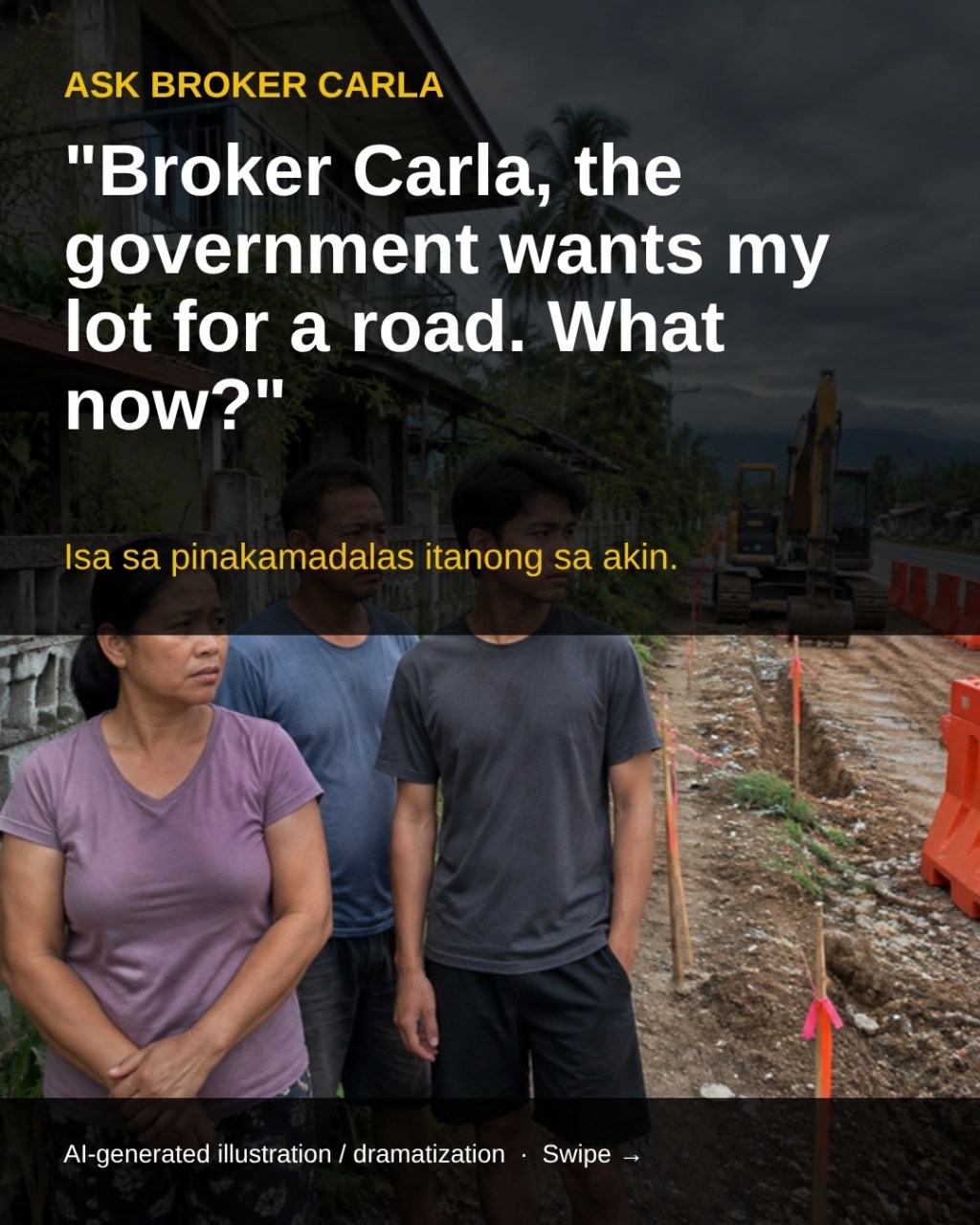
Isa sa pinakamadalas itanong sa akin: “Broker Carla, the government wants my property for a road. What can I do?”
The story
Aling Rosa’s family has lived beside the provincial road for 30 years. One morning, survey stakes appear in front of their hollow-block fence. A letter follows: part of their lot is needed for road widening. Her son asks the question every family asks: “Kukunin na lang ba nila? Magkano kaya ang ibabayad?” (This is a fictional story for illustration.)
The short answer
Yes, the government can take private property for a public project like a road. But it cannot take it for free. The 1987 Constitution (Article III, Section 9) says: “Private property shall not be taken for public use without just compensation.” For national government infrastructure projects, the Right-of-Way Act (Republic Act No. 10752) sets out how you should be offered payment, and what happens if you refuse.
The full explanation
Step 1: The offer (negotiated sale)
Under RA 10752, the government may acquire the land through donation, negotiated sale, expropriation or other modes allowed by law (Section 4). In a negotiated sale (Section 5), the offer covers the current market value of the land and the replacement cost of structures and improvements. If you accept, the law provides for payment of 50% of the negotiated price of the land at signing and the remaining 50% once the land is cleared of structures, improvements, crops and trees. In a negotiated sale, the implementing agency pays the capital gains tax for the seller.
Step 2: If you say no (expropriation)
If you reject the offer, the agency files an expropriation case in court (Section 6, RA 10752, together with Rule 67 of the Rules of Court). It must immediately deposit with the court, in your favor, 100% of the value of the land based on the current BIR zonal valuation. The court can then issue a writ of possession so the project can proceed. But the final just compensation is still for the court to decide, and the law directs the court to determine it within 60 days. In an expropriation, the law says the owner pays the capital gains tax and any unpaid real property tax.
How the court values your land
Section 7 lists standards the court may consider, including the classification and use for which the property is suited, the value declared by the owner, the current selling price of similar lands in the vicinity, and whether the payment would allow the owner to acquire similarly situated lands of approximate area.
What the Supreme Court said
In National Transmission Corporation v. Spouses Manalo, et al., G.R. No. 266921, January 22, 2024 (Second Division, Kho, Jr., J.), a 500-kV transmission line had been built across lots in Tanauan City, Batangas in 1998, without any expropriation case. The owners filed an inverse condemnation complaint in 2020 and asked for provisional compensation. The trial court ordered a deposit, and the Court of Appeals affirmed.
The Supreme Court denied TRANSCO’s petition and held that Section 6 of RA 10752 governs the provisional deposit, meaning 100% of the current BIR zonal value, because the owners’ complaint was filed after RA 10752 took effect. The lesson for owners: even when the government took land years ago without paying, the owner can still go to court to claim compensation.
Step by step: what to do
- Stay calm and don’t sign a quitclaim or waiver right away.
- Ask for the offer in writing, with the area affected, the price per square meter, and how the land and structures were valued.
- Check the numbers. Get the BIR zonal value for your area and gather evidence of selling prices of similar lots nearby.
- Document everything. Take dated photos of your house, fence, trees and other improvements.
- Negotiate or seek counsel. If the offer is too low, a lawyer can represent you in the expropriation case.
What this means for you
- The government can take your land for public use, but you have a constitutional right to just compensation.
- The first offer is not necessarily the final number. If you refuse, the court decides.
- Delay is not loss of rights: owners whose land was taken without payment can still claim compensation in court.
Documents to prepare: certified true copy of the title (Registry of Deeds), latest tax declaration, real property tax receipts, approved lot or survey plan, photos of structures and improvements, and the agency’s notice or letter.
Where to go: the implementing agency’s right-of-way office (for road projects, often the DPWH district engineering office), the Registry of Deeds, the BIR for zonal values, and a lawyer and the Regional Trial Court if the case is filed.
FAQ
Can I refuse to give up my land for a road?
You can refuse the offer, but the government can file an expropriation case. What you can contest in court is mainly the amount of just compensation and, in some cases, the authority or necessity of the taking.
How much is the deposit if the case goes to court?
Under Section 6 of RA 10752, 100% of the land’s value based on the current relevant BIR zonal valuation, deposited with the court in your favor.
Who pays the capital gains tax?
In a negotiated sale, the implementing agency pays it for the seller. In expropriation, RA 10752 says the owner pays the capital gains tax and any unpaid real property tax.
The government built on my land years ago and never paid. Is it too late?
Not necessarily. In TRANSCO v. Spouses Manalo (2024), owners whose land was used since 1998 sued in 2020, and the Supreme Court applied RA 10752 to their provisional deposit. Consult a lawyer about your specific facts.
Ask Broker Carla
May tanong ka rin? Comment ASK on my posts, message me at facebook.com/carlacallejabrokerphilippines, or email buyrentph@gmail.com. Send me your own “Broker Carla, …” question.
This article is for general information only and is not legal or tax advice. For your specific situation, consult a lawyer or a licensed professional.
Sources
- 1987 Constitution, Article III, Section 9
- Republic Act No. 10752 (Right-of-Way Act), March 7, 2016
- National Transmission Corporation v. Spouses Manalo, et al., G.R. No. 266921, January 22, 2024
- Rule 67, Rules of Court (Expropriation)
Cover image: AI-generated illustration / dramatization. Names in the story are fictional.

