By Carla Calleja, MBA, REB
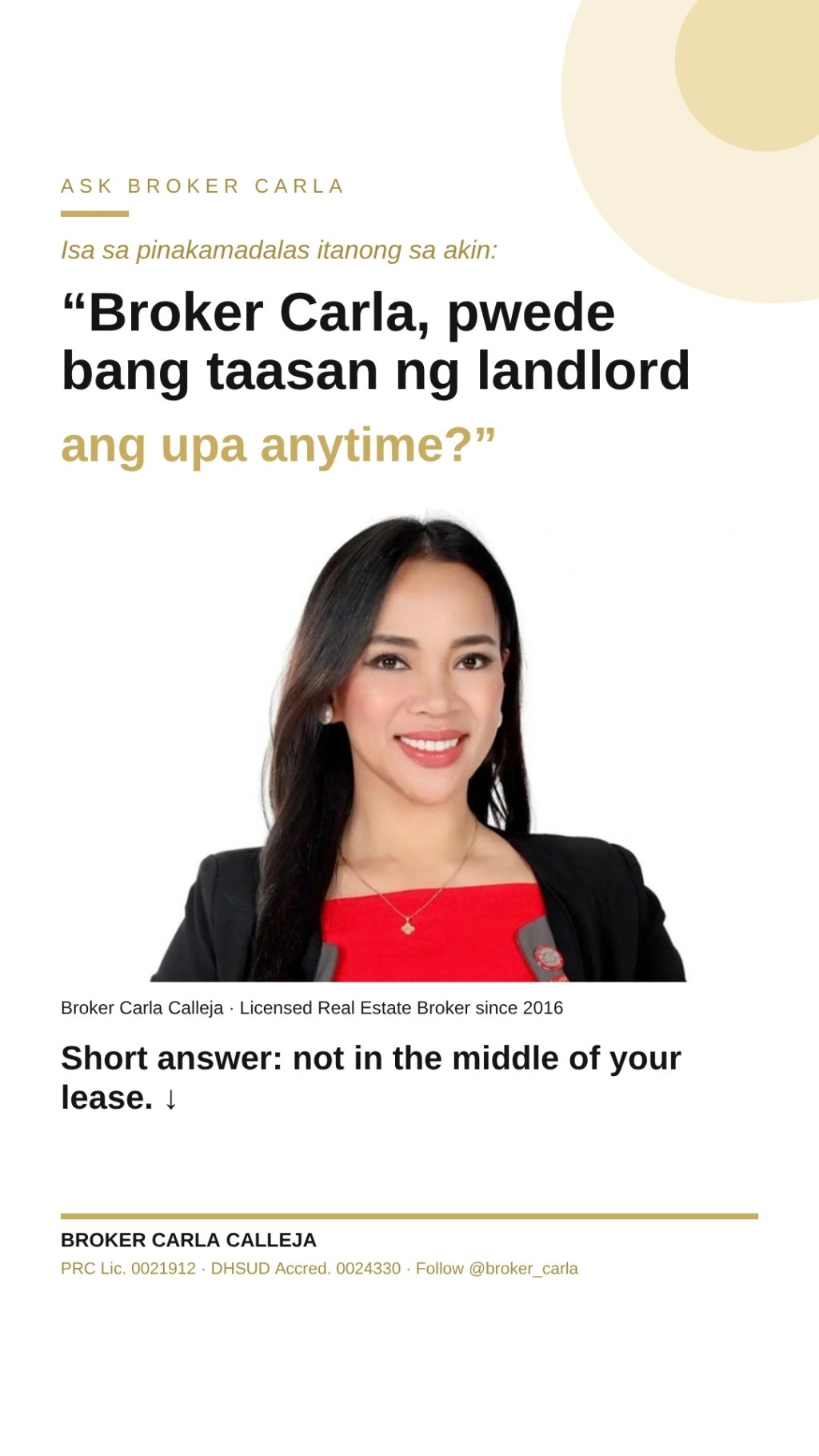
Isa sa pinakamadalas itanong sa akin: “Broker Carla, pwede bang taasan ng landlord ang upa anytime?” Tenants ask it when a surprise text arrives. Landlords ask it when their own bills go up. With inflation and interest rates climbing this year, it’s a fair question on both sides of the lease.
The story (a dramatization)
Mang Ben has rented the same ₱9,000-a-month apartment for three years. His current one-year lease runs until March. In November, his landlord texts: “Starting December, ₱10,800 na.” That’s a 20% jump, mid-lease. His officemate’s advice: “Huwag ka na lang magbayad hanggang bumaba.” Tempting. Also wrong. Here’s why.
The short answer
- Not in the middle of your lease, unless your contract has an escalation clause that allows it and its conditions are met. A lease binds both parties.
- If your rent is ₱10,000 a month or less and you’re the same tenant, the government cap for 2026 is 1% for the whole year.
- When the lease ends (or for higher-rent units not covered by rent control), the landlord can propose a new rate for the next term. You can negotiate, accept, or move out.
- Either way, don’t stop paying the agreed rent. That’s how tenants lose cases they could have won.
What the law says: rent control in 2025–2026
The Rent Control Act of 2009 (RA 9653) originally covered residential units in Metro Manila and other highly urbanized cities renting for up to ₱10,000 a month (₱5,000 elsewhere). It also lets the housing authorities continue rent regulation after its original term. Under that authority, the National Human Settlements Board issued NHSB Resolution No. 2024-01, which:
- continues rent regulation for residential units with monthly rent of ₱10,000 and below from January 1, 2025 to December 31, 2026, for as long as the unit is occupied by the same lessee;
- caps increases at 2.3% for 2025 and 1% for 2026;
- lets the owner set the initial rent for a new tenant when a unit becomes vacant, and exempts new units offered for lease;
- allows only one increase a year for boarding houses, dormitories, rooms and bedspaces for students.
RA 9653 also limits what a landlord of a covered unit can demand upfront: no more than one month advance rent and two months deposit (Sec. 7), and it penalizes violations with a fine of ₱25,000 to ₱50,000, imprisonment of one month and one day to six months, or both (Sec. 13). DHSUD encourages tenants and landlords to try barangay mediation first.
Above ₱10,000 a month? Most Makati and BGC condos are. Rent control doesn’t cap your increase, so your lease contract and the Civil Code govern. That’s where the Supreme Court case below matters.
What the Supreme Court says
In LL and Company Development and Agro-Industrial Corp. v. Huang Chao Chun, G.R. No. 142378, March 7, 2002 (Third Division), tenants leased a 1,112 sqm lot in Quezon City for five years. The lease allowed a rent increase upon presentation of a higher real estate tax bill. The landlord demanded a higher rent, the tenants disagreed, and they stopped paying altogether around 1993.
The Court sided with the tenants on the increase: since the lease terms were reciprocal, “we cannot … authorize a unilateral increase in the rental rate,” especially because the landlord had not complied with the tax condition in the contract. But the tenants still lost the case. The Court ordered them to vacate and to pay the accrued rentals at the stipulated rate with legal interest. It said that if a landlord refuses to accept rent, that is “not a valid defense”; the tenant’s remedy is consignation, depositing the rent in court under Article 1256 of the Civil Code.
Lesson: you can refuse an increase your contract doesn’t allow. You can’t refuse to pay the rent you already agreed to.
Step by step: what to do when the rent goes up
- Read your lease. Look for the rent, the term, renewal terms and any escalation clause (for example, “5% per year upon renewal”).
- Check if rent control applies. Monthly rent ₱10,000 or less and you’re the same tenant? The 2026 cap is 1%.
- Respond in writing. If the increase isn’t allowed by your contract or exceeds the cap, say so politely and propose to keep the agreed rent until the lease ends.
- Keep paying the agreed rent on time, and keep receipts. If the landlord refuses to accept it, talk to a lawyer about consignation.
- Can’t agree? Go to barangay mediation first (generally required if you both live in the same city or town), then consult a lawyer.
What this means for YOU
- Tenants: a mid-lease increase isn’t automatic. But withholding all rent turns a good argument into an ejectment case against you.
- Landlords: put escalation clauses in writing before the lease is signed, and time increases with renewals. For units ₱10,000 and below, stay within 1% this year.
- Buyers of tenanted condos: ask for the lease and check the escalation clause and expiry. A sale alone doesn’t end an existing lease (RA 9653 Sec. 10 for covered units).
Documents to keep: signed lease · rent receipts or bank transfer records · the landlord’s notice of increase · your written reply · barangay certificate, if it comes to that.
FAQ
My rent is ₱25,000 a month. Is there a legal cap on increases?
Not under the current rent control resolution, which covers ₱10,000 and below. Your lease governs: no increase mid-term unless the contract allows it, and a new rate can be negotiated at renewal.
Can my landlord evict me for refusing an increase?
Not mid-lease if you keep paying the agreed rent. When the lease expires, the landlord may decline to renew; for covered units, RA 9653 Sec. 9 lists the grounds for judicial ejectment, including expiration of the lease.
What happens after December 31, 2026?
NHSB Resolution 2024-01 covers 2025 and 2026 only. Watch for any new DHSUD or NHSB resolution for 2027. I’ll post an update once one is issued.
How much deposit and advance can a landlord ask for?
For units covered by RA 9653: at most one month advance and two months deposit. For other units, it depends on your agreement.
Related: Broker Carla, My Tenant Stopped Paying and Won’t Leave. How Do I Evict Them Legally?
Ask Broker Carla your own question
Rent increase, lease renewal or deposit problem? Send your question below and I will reply by email.
Ask Broker Carla
May tanong ka rin? Comment ASK on my Facebook page, message me ASK on Messenger, or email buyrentph@gmail.com with your own “Broker Carla, …” question. I may feature it (without your name) in a future post.
This article is for general information only and is not legal or tax advice. For your specific situation, consult a lawyer or a licensed professional.
Sources
- LL and Company Development and Agro-Industrial Corp. v. Huang Chao Chun, G.R. No. 142378, March 7, 2002 (Supreme Court E-Library)
- NHSB Resolution No. 2024-01, Rent Control 2025–2026 (DHSUD)
- Republic Act No. 9653, Rent Control Act of 2009 (LawPhil)
- Manila Bulletin: Government reduces monthly rent hike for residential units (Jan 4, 2025)
- PIA / DHSUD press release
- Civil Code, Art. 1256 (consignation)
ⓒ Broker CARLA CALLEJA
PRC License 0021912
DHSUD Accred. No. 0024330

