By Carla Calleja, MBA, REB
The story: “Kay Liza na ang lupa”
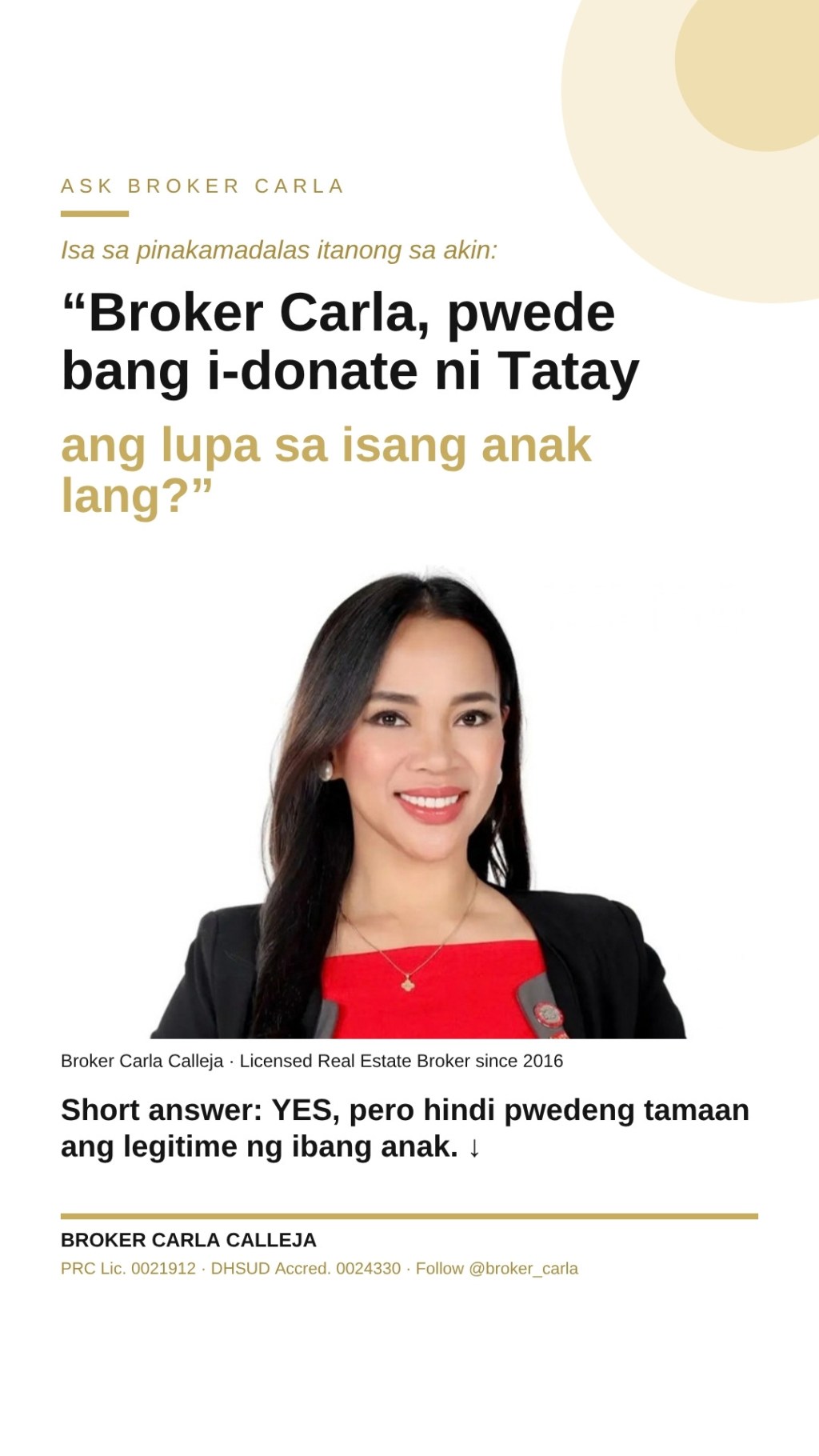
Isa sa pinakamadalas itanong sa akin: “Broker Carla, pwede bang i-donate ni Tatay ang lupa sa isang anak lang?”
Picture this (a dramatization; names are fictional). Mang Tonyo owned one lot. His youngest daughter, Liza, stayed with him and took care of him for years, so he signed a Deed of Donation giving her the whole lot. When he passed away, his other children found out. Wala nang ibang naiwang ari-arian. “Void ‘yan!” sabi ng mga kapatid. Liza says, “Binigay sa akin ni Tatay habang buhay pa siya.”
Sino ang tama? The answer surprises both sides.
The short answer
Yes, a parent may donate land to just one child. But the donation cannot impair the legitime of the other compulsory heirs. If it does, the donation is not void. It stays valid, but it can be reduced after the parent’s death, only to the extent it eats into the others’ legitime. And the other heirs must act within ten years from the parent’s death.
What the law says
- You cannot donate more than you could give by will. Civil Code Art. 752: no person may give or receive, by way of donation, more than he may give or receive by will. A parent with children can freely dispose only of the “free portion” of the estate; the rest is reserved by law as the children’s legitime (for legitimate children, one-half of the estate under Art. 888, shared equally, with the surviving spouse also entitled to a legitime).
- An excessive donation is “inofficious” and is reduced, not cancelled. Art. 771: donations that are inofficious, considering the estimated net value of the donor’s property at death, are reduced as to the excess. The reduction does not stop the donation from taking effect while the donor is alive.
- What a child received is counted against his or her share (collation). Arts. 908 and 1061: to compute the legitime, the value of donations is added back to the net estate, and a compulsory heir who received a donation brings its value into the partition. Under Art. 1062, a parent may expressly exempt the donation from collation, but even then it may still be reduced if it is inofficious.
- Form matters. Art. 749: a donation of land must be in a public document (a notarized deed) that describes the property, and the child’s acceptance must also be in a public document, made while the donor is alive.
What the Supreme Court said: Imperial v. Court of Appeals
In Imperial v. Court of Appeals, G.R. No. 112483, October 8, 1999 (Third Division), a father in Albay transferred a lot of more than 32,000 square meters to his son Eloy in 1951 through a “Deed of Absolute Sale” for ₱1.00. Both sides agreed it was really a donation. The father died in 1962, also survived by an adopted son, Victor. Decades later, Victor’s heirs sued, claiming the donation impaired Victor’s legitime because the father left no other property.
The Supreme Court explained that a complaint like this seeks the annulment “not of the entire donation, but only of that portion diminishing the legitime.” It also ruled on time limits: the ten-year prescriptive period applies to the obligation to reduce inofficious donations under Art. 771, and “the cause of action to enforce a legitime accrues upon the death of the donor-decedent.” Because the case was filed about 24 years after the father’s death, the claim had prescribed, and the Court reversed the lower courts. The Court added that in collation, what is brought back “is not the donated property itself, but the value of the property at the time it was donated.”
Back to Liza’s family: the donation is valid. Her siblings cannot simply call it void. If the lot exceeds what Mang Tonyo could freely give, they can ask that it be reduced to protect their legitime, but they must do so within ten years from his death.
Step by step: donating land to a child
- Deed of Donation. Notarized, describing the property (title number, lot, area), with the child’s acceptance in the same deed or in a separate notarized document.
- Donor’s tax. 6% of total gifts in excess of ₱250,000 in a calendar year (NIRC Sec. 99, as amended by the TRAIN Law, RA 10963). The donor’s tax return is filed within 30 days after the donation.
- Documentary stamp tax and BIR eCAR. Process the transfer at the BIR office with jurisdiction over the property to get the electronic Certificate Authorizing Registration.
- Local transfer tax. Paid at the city or provincial treasurer’s office (the Local Government Code covers transfers by donation).
- Registry of Deeds. Present the deed, eCAR and tax receipts to cancel the old title and issue a new one in the child’s name, then update the tax declaration at the assessor’s office.
I am not giving peso estimates for fees here because they depend on the property’s value and the LGU. Ask me and I can walk you through a computation for your specific lot.
What this means for you
- Parents: you may reward the child who cared for you, but list all your properties first. If the donation is larger than your free portion, expect it to be reduced later. A lawyer can help you structure it (for example, donating only the free portion, or balancing with other properties).
- The child who received the donation: keep the notarized deed, the acceptance, BIR receipts and the new title together. Know that the value may be counted against your share when the estate is settled.
- The other children: a donation is not automatically void just because you were left out. Your remedy is reduction, which you can ask for only after the parent’s death, and within ten years.
- Documents to prepare: owner’s duplicate title, latest tax declaration and real property tax receipts, valid IDs and TINs of donor and donee, proof of relationship (PSA birth certificate), and the notarized deed.
- Where to go: notary public, BIR, city/provincial treasurer, Registry of Deeds, assessor’s office. For disputes among heirs: barangay conciliation if the parties live in the same city or municipality, then the courts.
FAQ
Can the other children stop the donation while the parent is alive?
Generally no. Whether a donation is inofficious is determined based on the donor’s estate at death, so the remedy of reduction arises only after the parent dies.
Is a “sale” for ₱1 to one child safer than a donation?
No. In Imperial, the ₱1 “sale” was treated as what it really was: a donation. Simulated sales can also create tax problems.
Can a parent donate everything?
Under Art. 750, a donor must reserve enough for his own support and that of relatives entitled to support, and under Art. 752 a donation cannot exceed what he may give by will.
Is a donation better than leaving the lot in a will?
It depends on your family, the taxes, and timing. A donation takes effect now; a will takes effect at death. Both are subject to the legitime rules.
Ask Broker Carla
May tanong ka rin? Send me your own “Broker Carla, …” question: comment on my Facebook page facebook.com/carlacallejabrokerphilippines or email buyrentph@gmail.com. Licensed brokers help with all real estate concerns: titling, transfers, heirs’ property, sales and leasing.
This article is for general information only and is not legal or tax advice. For your specific situation, consult a lawyer or a licensed professional.

