

By Carla Calleja, MBA, REB · Licensed Real Estate Broker, Makati and BGC
“I’m a foreigner and I’ll pay in full cash. Can I even buy this?”

That is the exact question I received from three different foreign buyers in a single week, from Australia, France and the UK. Ang sagot: yes, you can buy a condominium unit. But not land, and not every unit. This guide explains the rules in plain words and gives you a checklist to use before you send a single peso.
Have a question already? Send me your inquiry by email using the form below and I’ll reply right away.
1. What a foreigner CAN and CANNOT own
- Land: no. The 1987 Constitution, Article XII, Section 7, says that except by hereditary succession, private lands may only be transferred to those qualified to hold lands of the public domain, meaning Filipino citizens and Filipino-majority corporations. So a house-and-lot cannot be titled in a foreign buyer’s name.
- Condominium unit: yes, within a limit. Under the Condominium Act (RA 4726, Section 5), a unit transfer is not valid if it would push the alien interest in the condominium corporation beyond the limits set by law. Because that corporation holds land, it must stay at least 60% Filipino, so foreigners as a group can hold up to 40%.
- Inheritance: yes. Hereditary succession is the one exception the Constitution itself allows.
What this means for you: before you fall in love with a unit, the building must confirm it still has room under its foreign-ownership quota. Some buildings in Makati and BGC are popular with expats and their quota can fill up.
2. Myth: “The new 99-year lease law lets foreigners own a house”
Not quite. Republic Act No. 12252 (2025) amended the Investors’ Lease Act and allows lease contracts of private land of up to 99 years in total. But the law applies to foreign investors with an approved and registered investment under RA 7042, and the leased area may be used solely for the purpose of that investment (Sec. 4, RA 7652 as amended). It is a tool for factories, tourism and similar projects, not a way to own a family home.
3. Former Filipinos: you may have more options
- Reacquired your Philippine citizenship (dual citizen under RA 9225)? Section 5 says you enjoy “full civil and political rights,” so you may buy land like any Filipino.
- Natural-born Filipino who is now a foreign citizen? Article XII, Section 8 of the Constitution allows you to be a transferee of private land, subject to limits. Under Batas Pambansa Blg. 185, that is up to 1,000 sqm of urban land or 1 hectare of rural land, to be used as your residence, and no more than two lots in different cities or municipalities.
4. Your foreign buyer’s checklist
- ☐ Ask the condominium corporation or administration to confirm in writing that the foreign-ownership quota still has room for your unit.
- ☐ Get a certified true copy of the Condominium Certificate of Title (CCT) from the Registry of Deeds and check that the seller’s name matches and that there are no liens or annotations you don’t understand.
- ☐ Ask for a dues clearance from the building admin: no unpaid association dues should come with your unit.
- ☐ Buying pre-selling? Ask for the project’s License to Sell from DHSUD before paying anything.
- ☐ Pay only through traceable bank channels, and keep every bank record. Never hand over cash.
- ☐ Make sure the Deed of Absolute Sale states the true price. The capital gains tax uses the higher of the selling price or the BIR zonal value anyway.
- ☐ Agree in writing who pays which taxes and fees before you sign.
- ☐ Work with a PRC-licensed real estate broker. Ask for the PRC license number and check it.
5. Warning: unlicensed “agents” are targeting foreign buyers
Foreign buyers stand out, and some people take advantage of that. Unlicensed “agents” are going around online (Facebook groups, marketplace posts and chat apps with copied listing photos), on the street (handing out flyers near malls and offices) and in building lobbies, waiting to approach anyone who looks new to the area. The pitch is usually the same: a “special price,” a unit “only for you,” and a reservation fee to be paid today.
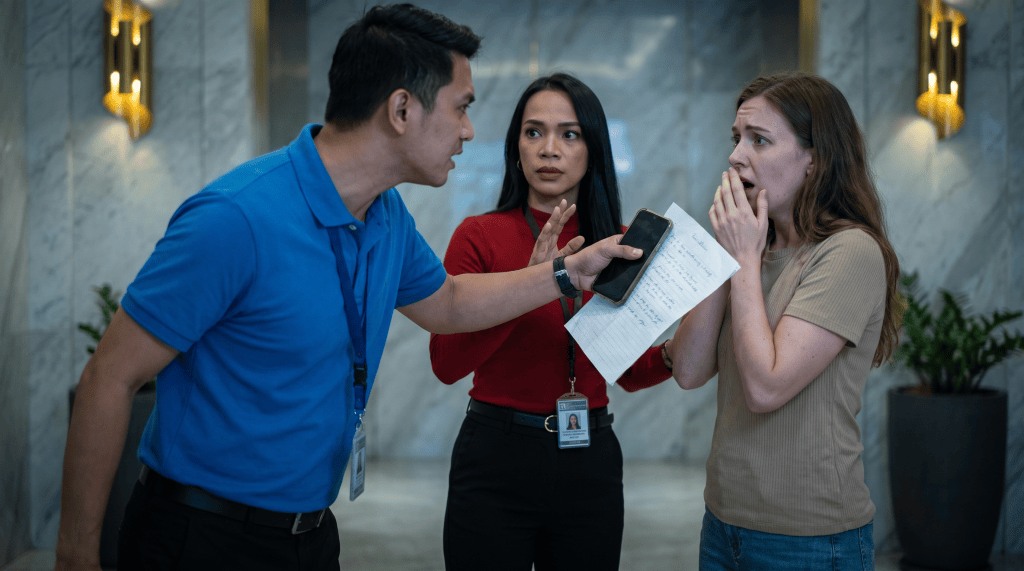
What the law says. Under the Real Estate Service Act of the Philippines (Republic Act No. 9646), no one may practice or offer to practice real estate brokerage, or even use a title that suggests they are a real estate practitioner, unless they passed the PRC licensure examination and hold a valid Certificate of Registration and Professional Identification Card. Real estate salespersons cannot act on their own: they must work under the supervision of a licensed broker. Violating the law carries a fine of at least ₱100,000, imprisonment of at least two years, or both.

Be careful who you deal with:
- Ask for the broker’s full name and PRC license number, and verify it with the Professional Regulation Commission (PRC) before you share documents or send money.
- If someone says they are a salesperson, ask which licensed broker supervises them, and verify that broker too.
- Ask to see the owner’s written authority to sell before viewing or paying anything.
- Never pay a reservation fee in cash or to a personal account. Pay only the developer or the owner through traceable bank channels, against an official receipt.
- If someone approaches you in a lobby or on the street, say no politely and check with the building administration.
- A price that seems too good to be true usually is.
6. How I guide foreign buyers

From the first viewing to the transfer of title, I walk foreign buyers through every step and every document: confirming the building’s foreign quota, checking the title at the Registry of Deeds, reviewing the contract and Deed of Absolute Sale, and coordinating the taxes and transfer. You will always know who you are dealing with: a PRC-licensed broker you can verify.
7. Not just buying: I help with every real estate concern
Leasing out your unit while you’re abroad, selling an inherited condo, transferring a title, settling dues disputes or managing a property from overseas: a licensed broker can help with all of it, not just the purchase.
Send your inquiry by email
Please send all inquiries by email. I check my inbox throughout the day, so this is the fastest way to get a reply. Use the form below, or email me directly at buyrentph@gmail.com with “FOREIGN BUYER” in the subject. Tell me your budget, preferred area (Makati or BGC), size, and whether the unit is for your own use or rental income. I’ll send you this checklist and a list of units that still have room under their foreign quota, so you can schedule viewings around your travel dates.


Already own a unit and thinking of selling? Get a free market assessment.
Sources: 1987 Constitution, Art. XII, Secs. 7–8; Republic Act No. 4726 (Condominium Act), Sec. 5; Republic Act No. 9225, Sec. 5; Batas Pambansa Blg. 185, Secs. 2–3; Republic Act No. 7652 as amended by Republic Act No. 12252, Sec. 4; Republic Act No. 9646 (Real Estate Service Act of the Philippines). Scenes marked “AI-generated” are dramatizations, not real events. This is general information, not legal or tax advice. For your specific situation, consult a Philippine lawyer.
Carla Calleja, MBA, REB
Licensed Real Estate Broker · PRC License 0021912 · DHSUD Accred. No. 0024330
Carla Calleja Real Estate

