By Carla Calleja, MBA, REB
The story: one “no” vote, a whole building stuck
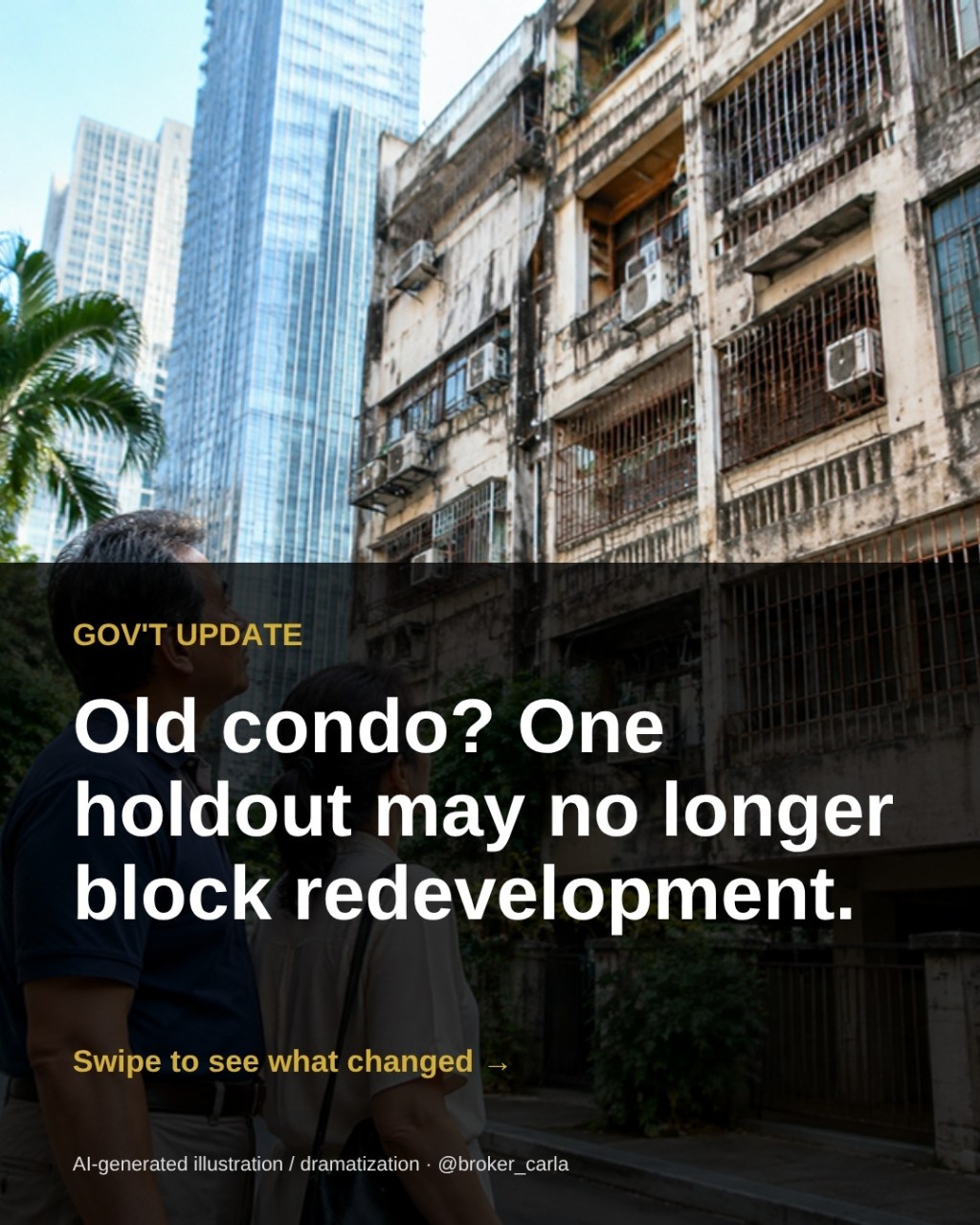
Picture a 1970s mid-rise in Makati. The elevators break down every month, the plumbing leaks, and a developer has offered to buy the whole property so it can be rebuilt. Most owners want to sell. A handful do not. Under the 1966 Condominium Act, that small group can effectively stop everyone else. This is the problem the proposed Condominium Redevelopment Act tries to fix.
The short answer
The Senate ratified the final version of the Condominium Redevelopment bill (Senate Bill 2420, with House Bill 2286 as the House version) on October 8, 2026. It updates Republic Act No. 4726, the Condominium Act of 1966. As of this writing, I have not found any report that the President has signed it, so it is not yet law. Its main change: dissolving a condominium corporation would no longer need a unanimous vote.
What the bill proposes
Based on the Senate version reported in September and October 2026 (the final enrolled text may differ):
- No more unanimous vote to dissolve a condominium corporation. The required approval depends on the age of the project.
- Projects 30 to 50 years old: approval of two-thirds.
- Projects 50 years or older: approval of a majority.
- Younger projects (under 30 years): a stricter rule involving owners in good standing; the reports do not give a single percentage, so check the final text.
- Two ways out: sell the whole project, or declare liquidating dividends to owners.
- Floor-area deviation limits simplified into three brackets of 1 to 3 percent.
- Reports also describe tax relief on conveying common areas to the condominium corporation; confirm the details once the law is published.
The Senate originally approved SB 2420 on third and final reading with 18 votes on September 1, 2026, then ratified the reconciled version on October 8. Sen. Chiz Escudero filed a related bill, SB 2569, on October 21 to exempt residential condo and subdivision common areas from real property tax (I covered that bill here).
Who is affected
- Owners in older buildings, especially in Makati, Manila and other early condo areas.
- Heirs who inherited a unit but never settled the estate. If the unit is still in a deceased parent’s name, voting and selling get complicated.
- Buyers of resale units in old buildings. A redevelopment vote could change your plans, for better or worse.
- Condominium corporations and developers looking at urban renewal.
What to do now: a step-by-step checklist
- Find your building’s age. Ask the admin office when the master deed was registered and when the building was completed.
- Get a copy of the master deed and declaration of restrictions, and the corporation’s by-laws.
- Keep your dues current. Good standing matters when votes are counted.
- Attend condo corporation meetings and ask whether redevelopment has been discussed.
- Heirs: settle the estate (extrajudicial settlement, estate tax, transfer of the Condominium Certificate of Title) so the right person can vote and sign.
- Get a valuation of your unit and your share in the land before any offer comes in.
- Wait for the final text. Do not sign any redevelopment agreement based on news reports alone.
FAQ
Is the Condominium Redevelopment Act already law?
Not as of November 6, 2026, based on my research. The Senate ratified the final version on October 8. It becomes law when the President signs it or when it lapses into law, and it usually takes effect after publication.
Can my condo be torn down without my consent?
Under the bill, a qualified vote of owners could approve dissolution, depending on the building’s age. That is why it matters to know your building’s age and to attend meetings.
What do I get if the building is sold?
The bill provides for either sale of the whole project or liquidating dividends. Your share should follow your interest in the project as stated in the master deed. Get a professional valuation.
Will this make old condos more valuable?
Possibly, for buildings on prime land, because redevelopment becomes easier. But every building is different. Ask a licensed broker to compare land value and unit value.
Ask Broker Carla
Do you own a unit in an older building? Comment CONDO on my Facebook page facebook.com/carlacallejabrokerphilippines, or email buyrentph@gmail.com with your “Broker Carla, …” question.
This article is for general information only and is not legal or tax advice. For your specific situation, consult a lawyer or a licensed professional.
Sources
- Dito sa Pilipinas, Oct 29, 2026: Escudero bills on condo tax relief and tower redevelopment
- Digicast Negros, Oct 12, 2026: Senate nod for housing-related measures
- The Manila Times, Sep 3, 2026: Senate OKs proposed condo law
- APAC Realty: Senate passes Condominium Redevelopment Act on final reading
- Republic Act No. 4726 (Condominium Act), Lawphil

