
By Carla Calleja, MBA, REB
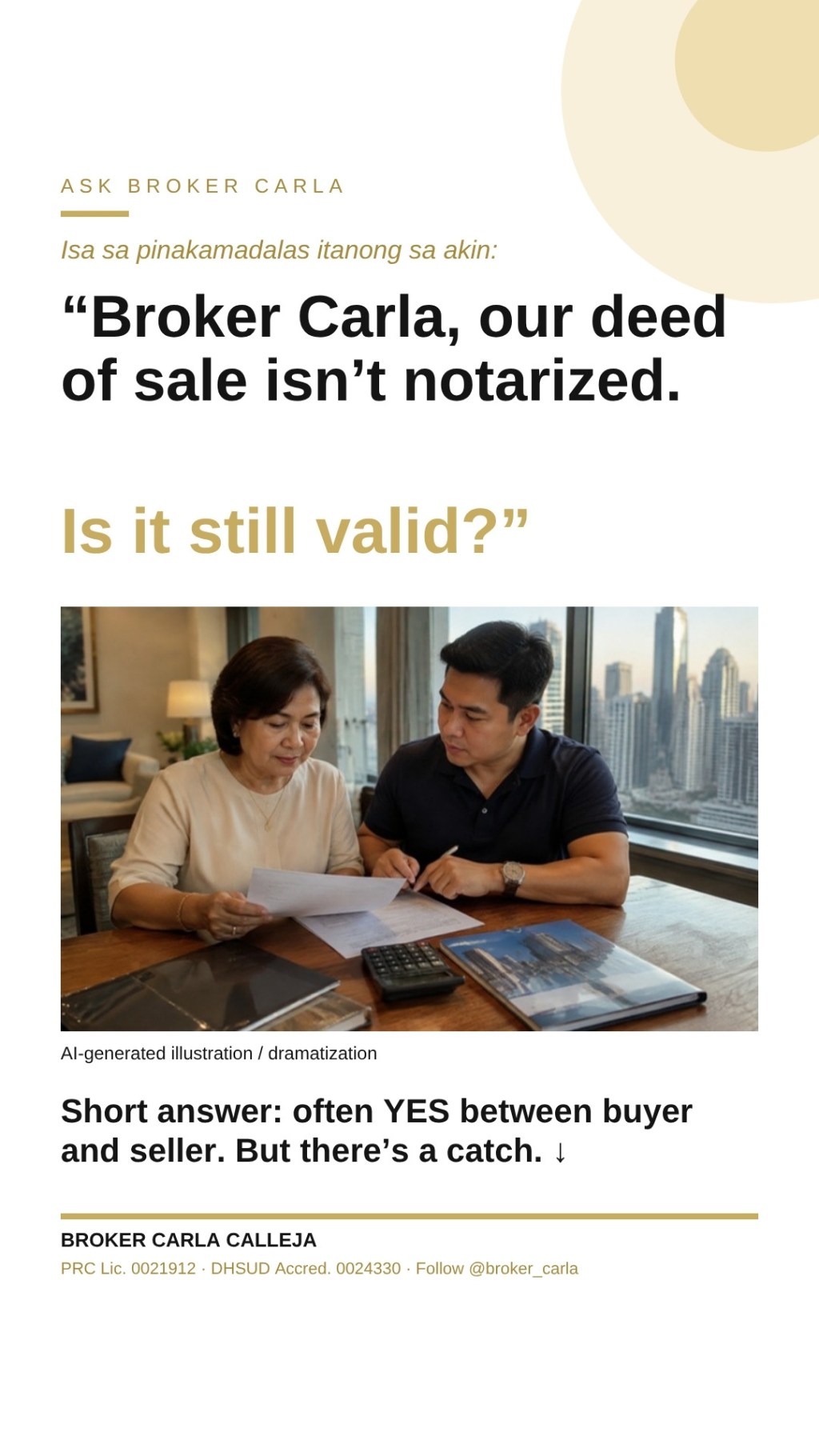
Isa sa pinakamadalas itanong sa akin: “Broker Carla, our deed of sale isn’t notarized. Is it still valid?”
The story (a dramatization)
Years ago, Aling Cora bought a small lot in Batangas from Mang Ramon. They wrote the deed of sale by hand, both signed it, and she paid in full. She moved in and planted mangoes. Nobody went to a notary.
Mang Ramon has since passed away. Now his children tell her: “Walang notaryo, walang bentahan. Amin pa rin ang lupa.” Are they right?
The short answer
Often, no. A sale of land written in a private document can be valid and binding between the buyer and the seller, and generally on the seller’s heirs too. The catch: an unnotarized deed cannot be registered, so the buyer cannot transfer the title and is less protected against third parties until the deed is put in a public instrument.
What the law and the Supreme Court say
In Spouses Dalion v. Court of Appeals and Sabesaje, G.R. No. 78903, February 28, 1990 (First Division), a seller in Sogod, Southern Leyte signed a private deed of absolute sale in 1965 but later refused to deliver the land, arguing that a sale of land must be in a public document. The trial court found his signature genuine and ordered him to deliver the land and sign a public deed. The Court of Appeals agreed, and so did the Supreme Court.
The Court held that a contract of sale “is a consensual contract,” perfected by mere consent, and “no particular form is required for its validity.” The requirement of a public document under Article 1358 of the Civil Code is “only for convenience, not for validity or enforceability.” Because the sale was perfected, either party could compel the other to execute a public instrument.
- Civil Code Art. 1356: contracts are obligatory in whatever form they are entered into, as long as the essential requisites are present.
- Art. 1357: once the contract is perfected, the parties may compel each other to observe the required form (for example, a notarized deed).
- Art. 1358: acts involving real rights over immovable property must appear in a public document. Per Dalion, this is for convenience.
- Art. 1311: contracts take effect between the parties, their assigns and heirs, except when the rights are not transmissible.
- PD 1529 Sec. 112: deeds and other voluntary instruments “executed in accordance with law in the form of public instruments shall be registrable.” A private deed is not.
Step by step: what Aling Cora (and you) should do
- Gather proof. The original signed deed, receipts of payment, tax declarations or real property tax receipts, and proof of possession (photos, witnesses, improvements).
- Ask the seller, or the heirs, to sign a notarized deed. If the seller has died, the heirs may need to settle the estate first so they can sign.
- If they refuse: go to the barangay for conciliation if you live in the same city or municipality. If that fails, a lawyer can file a case to compel execution of a public instrument. Don’t wait; time limits apply to court actions.
- After notarization: pay the taxes and get the eCAR from the BIR, pay the local transfer tax, then register with the Registry of Deeds for a new title.
What this means for you
- A private deed is not worthless. Keep it safe.
- But you cannot register it, so fix it while the seller is alive and cooperative.
- Buying land? Always insist on a notarized deed, signed in front of a notary who checks IDs.
Related: Can OFWs now notarize a deed online? and How heirs settle an inherited property.
FAQ
Is a deed signed in front of a barangay captain notarized?
No. Only a commissioned notary public, or an officer authorized by law to notarize, can make a document a public instrument.
Can the seller sell the same land again to someone else?
That is a double-sale problem. A buyer who registers in good faith may be preferred under the Civil Code, which is why registering quickly matters.
What if the deed is not even signed?
Then the problem is proving that a sale happened at all. Talk to a lawyer about the evidence you have.
Ask Broker Carla
May tanong ka rin? Comment ASK, send me your “Broker Carla, …” question on facebook.com/carlacallejabrokerphilippines, or email buyrentph@gmail.com.
This article is for general information only and is not legal or tax advice. For your specific situation, consult a lawyer or a licensed professional.
Sources
- Dalion v. Court of Appeals, G.R. No. 78903, Feb. 28, 1990 (decision text)
- PD 1529 (Property Registration Decree), Sec. 112
- Civil Code of the Philippines, Arts. 1311, 1356, 1357, 1358

