
By Carla Calleja, MBA, REB
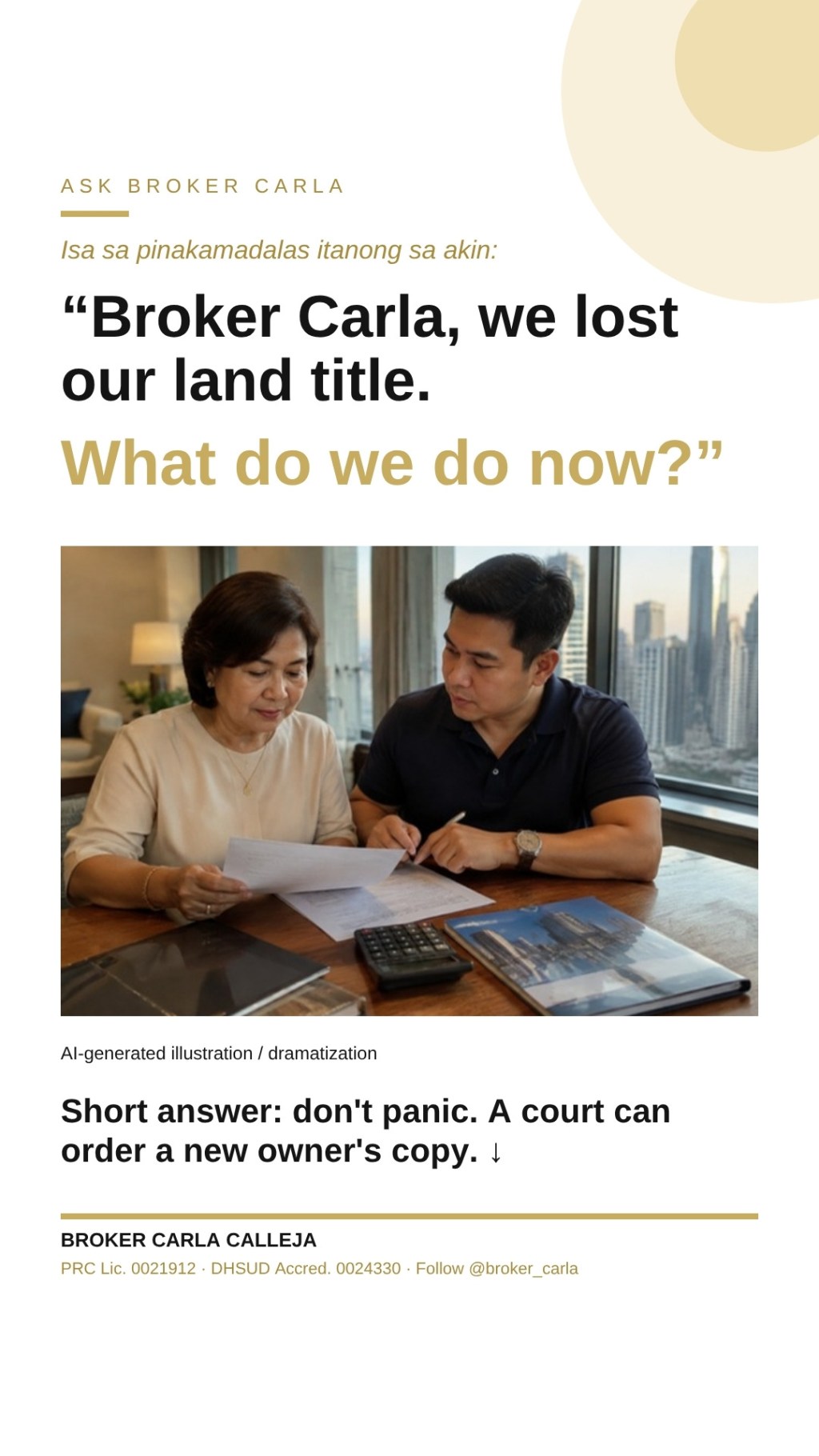
Isa sa pinakamadalas itanong sa akin: “Broker Carla, we lost our land title. What do we do now?”
The story: Aling Rosa can’t find it
Aling Rosa’s family moved houses years ago. Now a buyer wants their lot, but the owner’s copy of the title is nowhere to be found. A neighbor says, “Just sign an affidavit of loss. Tapos na.” Her son Mark isn’t so sure. (Aling Rosa and Mark are fictional; this is a dramatization, and the image is an AI-generated illustration.)
Mark is right to be careful. An affidavit is only the start.
The short answer
Don’t panic. If the owner’s duplicate of a Torrens title (the copy the owner keeps) is truly lost, the registered owner can ask the court to order a new one. The process is in Section 109 of Presidential Decree No. 1529, the Property Registration Decree. But the court can only do this if the title is really lost. If someone else is holding it, a new copy issued by the court is void.
What the law says
PD 1529, Section 109 covers a lost or destroyed owner’s duplicate certificate. The owner (or someone in interest) must send a sworn notice of the loss to the Register of Deeds. Then the registered owner or other person in interest files a petition in court, and the court may, after notice and due hearing, order the issuance of a new owner’s duplicate.
This is different from losing the original certificate kept at the Registry of Deeds (for example, after a fire or flood at the office). That situation is reconstitution of title under Republic Act No. 26, which PD 1529 Section 110 refers to.
What the Supreme Court says
New Durawood Co., Inc. v. Court of Appeals, G.R. No. 111732, February 20, 1996 (Third Division)
- Facts: A company owned three lots. Its branch manager filed a petition in the RTC of Antipolo for new owner’s duplicates, claiming the originals were lost, supported by a stockholder’s affidavit of loss. The court granted it, and the old titles were later cancelled and new titles issued to another company.
- The twist: the owner’s duplicates were never lost. The company’s board chairman had them all along.
- Ruling: Section 109 of PD 1529 governs new owner’s duplicates; RA 26 applies only to lost originals. Because the titles were not actually lost, the trial court never acquired jurisdiction. The Supreme Court annulled the proceedings and declared the new titles null and void. The Court also stressed that courts must verify that the petitioner is truly the registered owner or a person in interest, so impostors cannot abuse the Torrens system.
Read the full decision: New Durawood Co., Inc. v. CA, G.R. No. 111732 (Lawphil).
Step by step: what to do
- Search thoroughly. Ask who last held it: a bank (if the property was mortgaged), relatives, a co-owner, a former buyer, or a lawyer.
- Get a certified true copy of the title from the Registry of Deeds where the land is registered. This shows the title number and any annotations.
- Execute an affidavit of loss and send a sworn notice of loss to the Register of Deeds, as Section 109 requires.
- File a petition in the Regional Trial Court where the land is located, with the help of a lawyer. Expect notice and a hearing.
- Once granted, present the court order to the Registry of Deeds for the new owner’s duplicate.
Costs: these usually include notarial fees, Registry of Deeds certification fees, court filing fees and lawyer’s fees. I am not giving amounts because I could not confirm a current official fee schedule; ask your Registry of Deeds and lawyer for a quote.
What this means for you
- An affidavit of loss alone does not replace a title. A court order is needed for a new owner’s duplicate.
- Never claim a title is lost if someone else has it. The new title can be voided, and you may face liability.
- Selling soon? Start early. A buyer, bank or BIR transfer will need the owner’s duplicate.
Documents to prepare: certified true copy of the title, tax declaration and real property tax receipts, valid IDs, affidavit of loss, and proof that you are the registered owner or an heir (for example, death certificate and settlement documents).
Where to go: Registry of Deeds, a notary public, the Regional Trial Court (through a lawyer), and the city or municipal assessor for tax records.
FAQ
Can I sell land if the title is lost? The sale can’t be registered without the owner’s duplicate, so get a new one first.
What if the title is with the bank? Then it is not lost. Pay off or settle the loan and ask the bank to release it.
What if the Registry of Deeds’ original was destroyed? That is reconstitution under RA 26, a different process.
The owner has died. Can heirs file? Section 109 allows the registered owner or “other person in interest” to file; heirs should also settle the estate. Ask a lawyer about your case.
Ask Broker Carla
May tanong ka rin? Comment LOST for my checklist, or send me your own “Broker Carla, …” question on facebook.com/carlacallejabrokerphilippines or by email at buyrentph@gmail.com.
This article is for general information only and is not legal or tax advice. For your specific situation, consult a lawyer or a licensed professional.
Sources
- New Durawood Co., Inc. v. Court of Appeals, G.R. No. 111732, Feb. 20, 1996 (Lawphil)
- Presidential Decree No. 1529 (Property Registration Decree), Sections 109 and 110
- Republic Act No. 26 (reconstitution of Torrens certificates of title)

