
By Carla Calleja, MBA, REB
The story: “Mura, pero may nakatira”
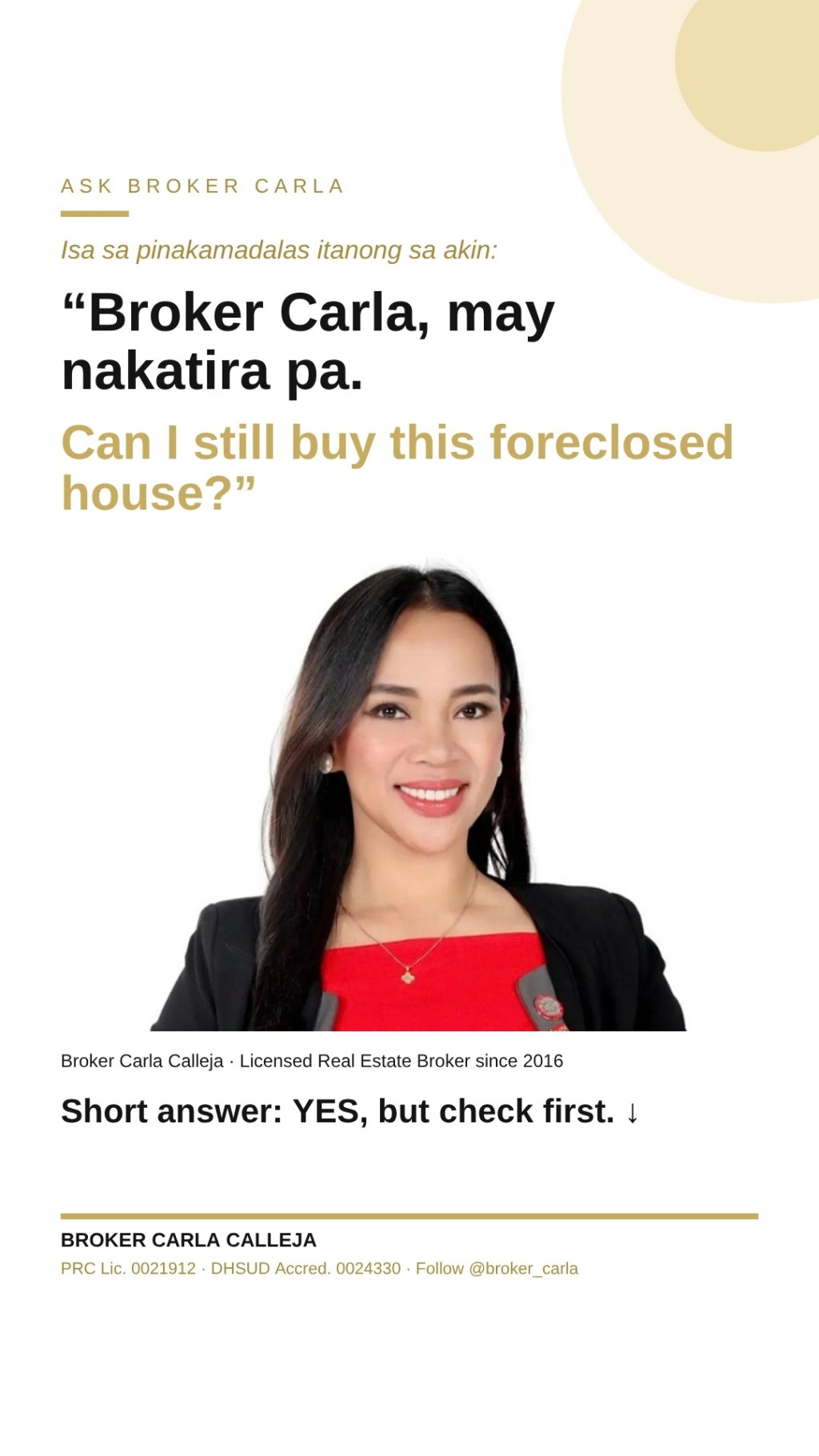
Isa sa pinakamadalas itanong sa akin: “Broker Carla, may nakatira pa. Can I still buy this foreclosed house?”
Here’s a typical scenario (a dramatization, with fictional names). Mang Jun finds a bank-foreclosed house listed well below what similar homes in the area are asking. He visits, and the problem is right at the gate: the former owner’s family still lives there. The bank says the property is sold “as is, where is.” Mang Jun likes the price, but he’s afraid he’ll pay millions and end up in a fight he can’t win. Pwede ba siyang bumili? And who gets the occupants out?
The short answer
Yes, you can buy it. When you buy a foreclosed property from the bank that acquired it, you generally step into the bank’s shoes, including its right to ask the court for a writ of possession. But an occupied property means more time, more cost and more risk, so check a few things before you pay.
What the law says
Most bank foreclosures of real estate mortgages are done out of court (extrajudicially) under Act No. 3135, as amended. The key parts:
- Redemption (Sec. 6): an individual borrower generally has one year from registration of the certificate of sale to redeem the property. For juridical (corporate) borrowers whose lender is a bank, the General Banking Law (RA 8791, Sec. 47) shortens this: redemption is allowed only until registration of the certificate of sale, and never more than three months after the foreclosure.
- Writ of possession (Sec. 7): the buyer at the auction can ask the court to be placed in possession. Once the redemption period has lapsed and title is consolidated in the buyer’s name, issuing the writ is a ministerial duty of the court.
- Sec. 8: the former owner may question the sale, but the order of possession stays in force while that challenge is pending.
What the Supreme Court says: Gatuslao v. Yanson
In Spouses Gatuslao v. Yanson, G.R. No. 191540, January 21, 2015 (Second Division), a borrower mortgaged two lots in Bacolod City to PNB. He defaulted, PNB foreclosed, won the auction and consolidated title after the redemption period lapsed. Years later, PNB sold the lots to a private buyer, who got new titles in his name and asked the court for a writ of possession. The former owner’s heirs were living on the property. They argued the buyer was not the auction purchaser and that a pending annulment case should stop the writ.
The Supreme Court ruled for the buyer:
- As PNB’s transferee or successor-in-interest, the buyer was entitled to use Section 7 of Act 3135 “as if he is PNB.”
- After the redemption period expired without redemption, issuing the writ was a ministerial duty of the court upon proper application and proof of title, and it stays ministerial until a court actually annuls the foreclosure sale.
- The heirs were not “third parties” holding the property adversely. They derived their possession from the former owner, so they could not block the writ.
The important exception: if the occupant is a true third party holding the property adversely to the former owner (for example, someone claiming ownership in their own right, not through the borrower), the writ is no longer ministerial and cannot be issued ex parte. That third party gets a hearing, and things take longer.
Step by step: buying an occupied foreclosed property
- Get a certified true copy of the title from the Registry of Deeds. Is title already consolidated in the bank’s name? Look for annotations (certificate of sale, affidavit of consolidation, lis pendens, adverse claims).
- Check the redemption period. If it has not yet lapsed, the former owner may still redeem, and your purchase could unravel.
- Find out who the occupants are and on what basis: the former owner and family, their heirs, a tenant, or someone claiming ownership on their own. This decides how hard getting possession will be.
- Ask if there’s a pending case to annul the mortgage or the foreclosure. It doesn’t automatically stop a writ, but you should know about it.
- Read the bank’s sale terms. “As is, where is” usually means you handle ejectment and its costs. Ask in writing who files for the writ, who pays, and what happens to unpaid real property tax, association dues and utilities.
- See a lawyer before you pay. Even a ministerial writ needs a court petition, a sheriff and time.
About costs: I’m not giving peso figures here because they vary by court, location and case. Budget for legal fees, court and sheriff’s fees, transfer taxes and registration, back taxes or dues if the bank won’t shoulder them, and a few months of waiting.
What this means for you
- An occupied foreclosed house can be a good deal, but the discount is partly payment for the time and risk of getting possession.
- If the occupants are the former owner or people claiming through them, the law is on the buyer’s side once title is consolidated.
- If the occupant claims ownership in their own right, expect a hearing and a longer process.
- Documents to prepare: certified true copy of the title, tax declaration, certificate of sale and affidavit of consolidation (from the bank or Registry of Deeds), the bank’s sale terms, and your deed of sale.
- Where to go: Registry of Deeds (title), the assessor’s and treasurer’s offices of the LGU (tax declaration and real property tax), BIR (transfer taxes), and a lawyer for the writ.
If you’re on the other side, a borrower facing foreclosure, read my earlier guide: Broker Carla, our house was foreclosed. Will an appeal stop the bank?
FAQ
Can I get a writ of possession if I bought from the bank, not at the auction?
Yes. In Gatuslao v. Yanson, the Supreme Court held that a buyer from the bank, as its successor-in-interest, may use Section 7 of Act 3135 just as the bank could.
Will a pending case filed by the former owner stop me?
Not by itself. The writ remains ministerial until a court actually annuls the foreclosure sale. Still, a pending case is a risk you should weigh with your lawyer.
What if the occupant is a tenant or someone else?
It depends on their claim. Someone holding the property adversely to the former owner is entitled to be heard, so the writ can’t simply be issued ex parte. Find out who they are before you buy.
Can the former owner still take the house back?
Only within the redemption period, or if a court annuls the foreclosure. That’s why you confirm the redemption period has lapsed and title has been consolidated before paying.
Ask Broker Carla
May tanong ka rin? Comment ASK on my Facebook page, message me ASK on Messenger, or email buyrentph@gmail.com with your own “Broker Carla, …” question. Follow @broker_carla for more.
This article is for general information only and is not legal or tax advice. For your specific situation, consult a lawyer or a licensed professional.
Sources
- Spouses Gatuslao v. Yanson, G.R. No. 191540, January 21, 2015 (Supreme Court E-Library)
- Act No. 3135, as amended by Act No. 4118, Secs. 6, 7 and 8
- Republic Act No. 8791 (General Banking Law of 2000), Sec. 47
- Related: foreclosure and appeals (Jayag v. BDO Unibank, G.R. No. 222503)

