By Carla Calleja, MBA, REB
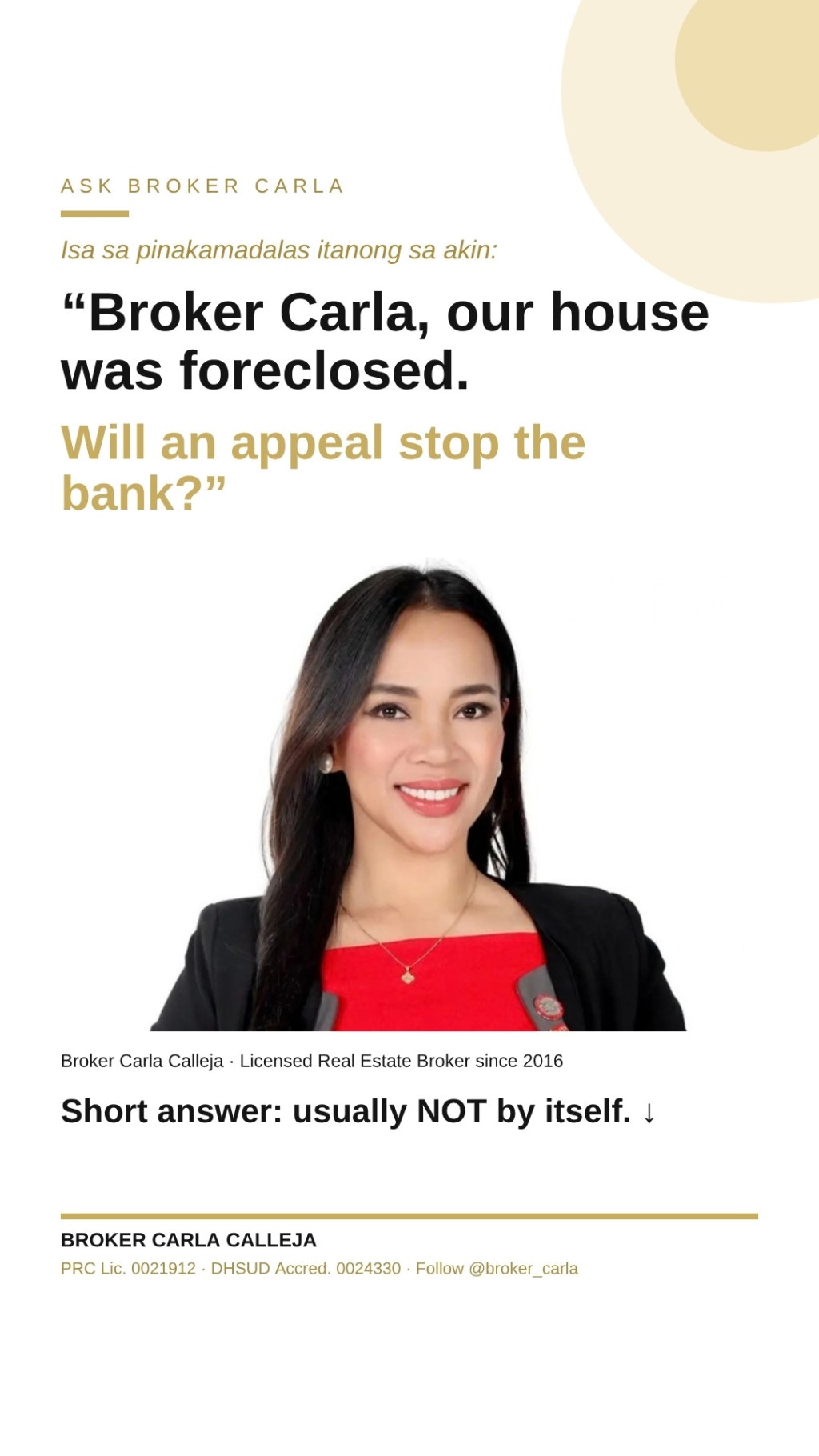
Isa sa pinakamadalas itanong sa akin: “Broker Carla, our house was foreclosed. If we appeal, can the bank still take it?” It is a painful question, and I want to answer it honestly so you can act while you still have options.
The story: “Nag-appeal na kami!”
(A dramatization; the names are fictional.) Aling Rosa and Mang Ben fell behind on the housing loan secured by their home. The bank foreclosed the mortgage out of court and was the highest bidder at the auction. A year went by and they never redeemed the house. The bank asked the court for a writ of possession, and the court granted it. The couple appealed, sure that the appeal would buy them time. Then the sheriff came anyway.
Tama ba ito? In most cases, yes. Here’s why.
The short answer
An appeal does not, by itself, stop the buyer at a foreclosure sale (usually the bank) from taking possession. Once the redemption period has lapsed and the title has been consolidated in the buyer’s name, issuing the writ of possession is a ministerial duty of the court. Filing an appeal, or even a separate case to annul the mortgage, does not automatically suspend it.
What the law says: Act No. 3135
Most bank foreclosures of real estate mortgages in the Philippines are done out of court under Act No. 3135, as amended. Key rules:
- Notice (Sec. 3): notice of the sale must be posted for at least 20 days in at least three public places in the city or municipality where the property is, and, if the property is worth more than ₱400, published once a week for three consecutive weeks in a newspaper of general circulation.
- Redemption (Sec. 6): the debtor and certain others may redeem the property within one year. The Supreme Court counts this year from the registration of the certificate of sale with the Registry of Deeds. (Juridical persons such as corporations that mortgaged to a bank have a shorter window under Sec. 47 of the General Banking Law, RA 8791. Ask your lawyer.)
- Possession (Sec. 7): the buyer may ask the court for a writ of possession, even during the redemption period by posting a bond.
- The debtor’s remedy (Sec. 8): the debtor may petition to set aside the sale and cancel the writ (for example, because the mortgage was not violated or the sale did not follow the law), within 30 days after the buyer was given possession. Either party may appeal, but the order of possession stays in force while the appeal is pending.
What the Supreme Court says: Jayag v. BDO Unibank
In Jose P. Jayag and Marilyn P. Jayag v. BDO Unibank, Inc., G.R. No. 222503, September 14, 2021 (First Division, Gesmundo, C.J.), a couple’s Makati property was foreclosed and sold at auction to the bank. The redemption period expired in July 2014. The couple had filed a separate case to annul the foreclosure, and a trial court even declared the foreclosure void, but that ruling was still on appeal. Meanwhile, another branch granted the bank a writ of possession.
The Supreme Court denied the couple’s petition. It held that after the redemption period lapses and title is consolidated, the court’s duty to issue the writ is ministerial (“The trial court has no discretion on this matter”), and that a pending action to annul the mortgage or foreclosure does not bar the writ. It also held that after redemption lapses, the debtor “may no longer avail of the remedy under Section 8” and must pursue a separate action instead.
The Court recognized narrow exceptions where the writ should not issue as a matter of course: for example, gross inadequacy of the price, a third party in possession claiming a right adverse to the debtor, or the buyer’s failure to pay the surplus of the sale proceeds to the mortgagor.
In the news this week: the Daily Tribune and The Manila Times reported (Nov. 10–11, 2026) an April 7, 2026 Third Division decision in a case involving spouses and PNB that again held that an appeal does not stop the takeover of foreclosed property. I have not yet been able to read the full text of that decision, so I rely here on the Jayag ruling above.
Step by step: what you can still do
- Before foreclosure: talk to the bank early. Ask about restructuring or other arrangements, and get any agreement in writing.
- Read every notice. Check whether the notice of sale was properly posted and published. Defects can be grounds to question the sale.
- After the auction: get a copy of the certificate of sale from the Registry of Deeds and note the registration date. That date starts your one-year redemption clock (for individuals).
- Redeem if you can. Ask the bank in writing for the exact redemption amount well before the deadline.
- Questioning the foreclosure? See a lawyer immediately. A case alone will not stop the writ; only a court order (such as an injunction) can, and courts grant these sparingly.
Costs: redemption amounts and legal fees depend on your loan, the bid price and your lawyer, so I won’t guess numbers here. Ask the bank for a written computation.
What this means for you: checklist
- Loan agreement, promissory note and real estate mortgage
- Demand letters and every notice from the bank
- Notice of sheriff’s sale and proof of posting/publication
- Certificate of sale and its registration date (Registry of Deeds)
- Certified true copy of the title
- Your proof of payments
Still paying in installments to a developer, not a bank? Different rules may apply. See my guide on the Maceda Law and refunds. Thinking of buying a foreclosed home instead? Read what to check before you bid.
FAQ
How long do I have to redeem a foreclosed property?
Under Act 3135, generally one year, counted (per the Supreme Court) from registration of the certificate of sale. Corporations mortgaging to banks have a shorter period under RA 8791.
Can the bank take possession during the redemption year?
Yes. Under Sec. 7 of Act 3135, the buyer may get a writ of possession during the redemption period by posting a bond.
If I win my case later, do I get the house back?
Possibly. In Jayag, the Court noted the spouses could later ask the trial court to cancel the writ once the nullification of the foreclosure became final. That’s why the separate case matters, even if it doesn’t stop the writ right away.
Is a Section 8 petition still available after one year?
According to Jayag, no. Once the redemption period has lapsed and title is consolidated, the debtor must file a separate action.
Ask Broker Carla
May tanong ka rin? Comment ASK on my Facebook page, message me ASK on Messenger, or email buyrentph@gmail.com with your “Broker Carla, …” question. Your question could be next.
This article is for general information only and is not legal or tax advice. For your specific situation, consult a lawyer or a licensed professional.

