
By Carla Calleja, MBA, REB
Isa sa pinakamadalas itanong sa akin: “Broker Carla, a relative has lived on our land for 30 years. Can they claim it?” It comes up a lot when a family finally decides to sell, partition or build on a lot that an uncle, a cousin or a long-time caretaker has been staying on for decades.
The story (a dramatization)
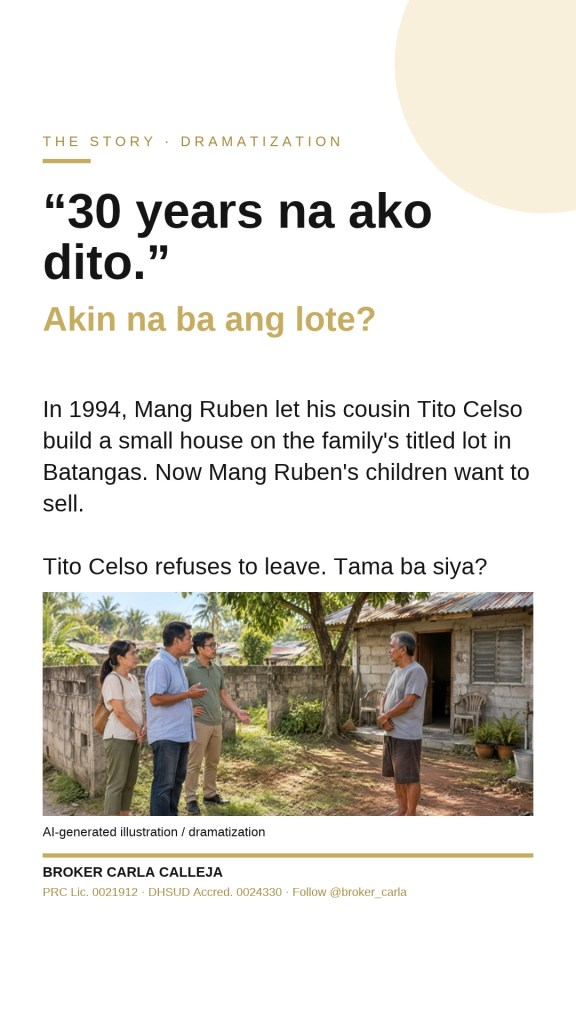
In 1994, Mang Ruben let his cousin, Tito Celso, build a small house on the family’s titled lot in Batangas. No rent, no contract, just “pamilya naman tayo.” Mang Ruben has since passed away, and his children now want to sell the lot.
Tito Celso refuses to leave. “Thirty years na ako dito. Akin na ‘to.” The children are worried. Did 30 years of living there make Tito Celso the owner?
The short answer
If the land is covered by a Torrens title (OCT or TCT), no. Nobody becomes the owner of titled land just by staying on it, no matter how long. And a relative who stayed because the owner allowed it has an even weaker claim, because possession by permission does not count toward ownership at all.
If the land is untitled (for example, only covered by a tax declaration), the answer can be different. More on that below.
What the law says
- Property Registration Decree (PD 1529), Section 47: “No title to registered land in derogation of the title of the registered owner shall be acquired by prescription or adverse possession.”
- Civil Code, Article 1119: “Acts of possessory character executed in virtue of license or by mere tolerance of the owner shall not be available for the purposes of possession.” In plain words: if you stayed because the owner let you, those years don’t count.
- Civil Code, Article 1118: possession that can lead to ownership must be “in the concept of an owner, public, peaceful and uninterrupted.”
- Civil Code, Article 494: if the occupant is himself a co-heir or co-owner, prescription does not run in his favor while he recognizes the co-ownership.
What the Supreme Court said
In Heir of Pastora T. Cardenas and Eustaquio Cardenas v. The Christian and Missionary Alliance Churches of the Philippines, Inc., G.R. No. 222614, March 20, 2019 (Second Division, Caguioa, J.), a church had been occupying a 410-square-meter titled lot in Midsayap, Cotabato since 1962. It claimed it had bought the lot, but the deed of sale could not be found. In 2009, the registered owners’ heir sued to recover possession. The trial court and the Court of Appeals ruled for the church.
The Supreme Court reversed. It held that acquisitive prescription does not apply to registered land, and that “the right to recover possession of registered land is imprescriptible on the part of the registered owner.” It also rejected laches, because the heir had been negotiating with the church for years before filing suit. The church was ordered to turn over the lot, except for a 110-square-meter portion that its own witness and the heir both acknowledged had been sold.
Lesson: even nearly five decades of occupation did not beat a Torrens title. But notice the exception. Whatever was really sold, and proven, stayed with the buyer.
What if the land is untitled?
For private land that is not under the Torrens system, the Civil Code allows ownership to be acquired by prescription:
- Ordinary prescription, 10 years (Art. 1134), for a possessor in good faith and with just title.
- Extraordinary prescription, 30 years (Art. 1137): “uninterrupted adverse possession thereof for thirty years, without need of title or of good faith.”
Even then, the possession must be adverse and in the concept of an owner. A relative who stayed with the family’s permission is not possessing adversely. Land that is still public land of the State follows different rules. If your family only has a tax declaration, this is the time to talk to a lawyer and to start titling the land. (See my guide: Broker Carla, I only have the tax declaration. How do I get it titled?)
What this means for you: a step-by-step checklist
- Get a certified true copy of the title from the Registry of Deeds and confirm it is in your family’s (or the deceased owner’s) name.
- Gather proof that the stay was by permission: letters, text messages, witnesses, and real property tax receipts paid by your family.
- If the owner has died, settle the estate so the heirs can act together. See: How do we get our rightful shares?
- Send a written demand to vacate, preferably through a lawyer, and keep proof of receipt.
- Talk first. If you and the occupant live in the same city or municipality, barangay conciliation generally comes before a court case.
- No deal? With a lawyer, file an ejectment case (unlawful detainer) in the municipal or city court within one year from the last demand. After one year, the remedy is generally an accion publiciana in the proper court.
Selling? Tell your broker upfront that someone is occupying the lot. Buyers and banks will ask, and an occupied lot is harder to sell until possession is resolved.
FAQ
He has paid the real property tax for years. Does that make him the owner?
No. Tax declarations and receipts are evidence of a claim of possession, but they don’t defeat a Torrens title.
He built a house on our land. Do we have to pay for it?
It depends on whether he built in good faith and on what was agreed. This is a question for your lawyer before you file anything.
Can we lose the land because we waited too long?
The registered owner’s right to recover titled land does not prescribe, but the courts can apply laches in rare cases of unreasonable, unexplained delay. Don’t sit on it.
What if the relative is also an heir?
Then he is a co-owner, not a stranger. He can’t claim the whole lot by prescription while he recognizes the co-ownership (Art. 494). The usual solution is partition.
Ask Broker Carla
May tanong ka rin? Comment ASK on my Facebook page facebook.com/carlacallejabrokerphilippines, send me your “Broker Carla, …” question, or email buyrentph@gmail.com.
This article is for general information only and is not legal or tax advice. For your specific situation, consult a lawyer or a licensed professional.
Sources
- Heir of Cardenas v. CAMACOP, G.R. No. 222614, March 20, 2019 (Supreme Court E-Library)
- G.R. No. 222614 (Lawphil)
- Civil Code of the Philippines, RA 386 (Lawphil): Arts. 494, 1118, 1119, 1134, 1137
- Presidential Decree No. 1529 (Property Registration Decree), Sec. 47, as quoted in G.R. No. 222614

