By Carla Calleja, MBA, REB
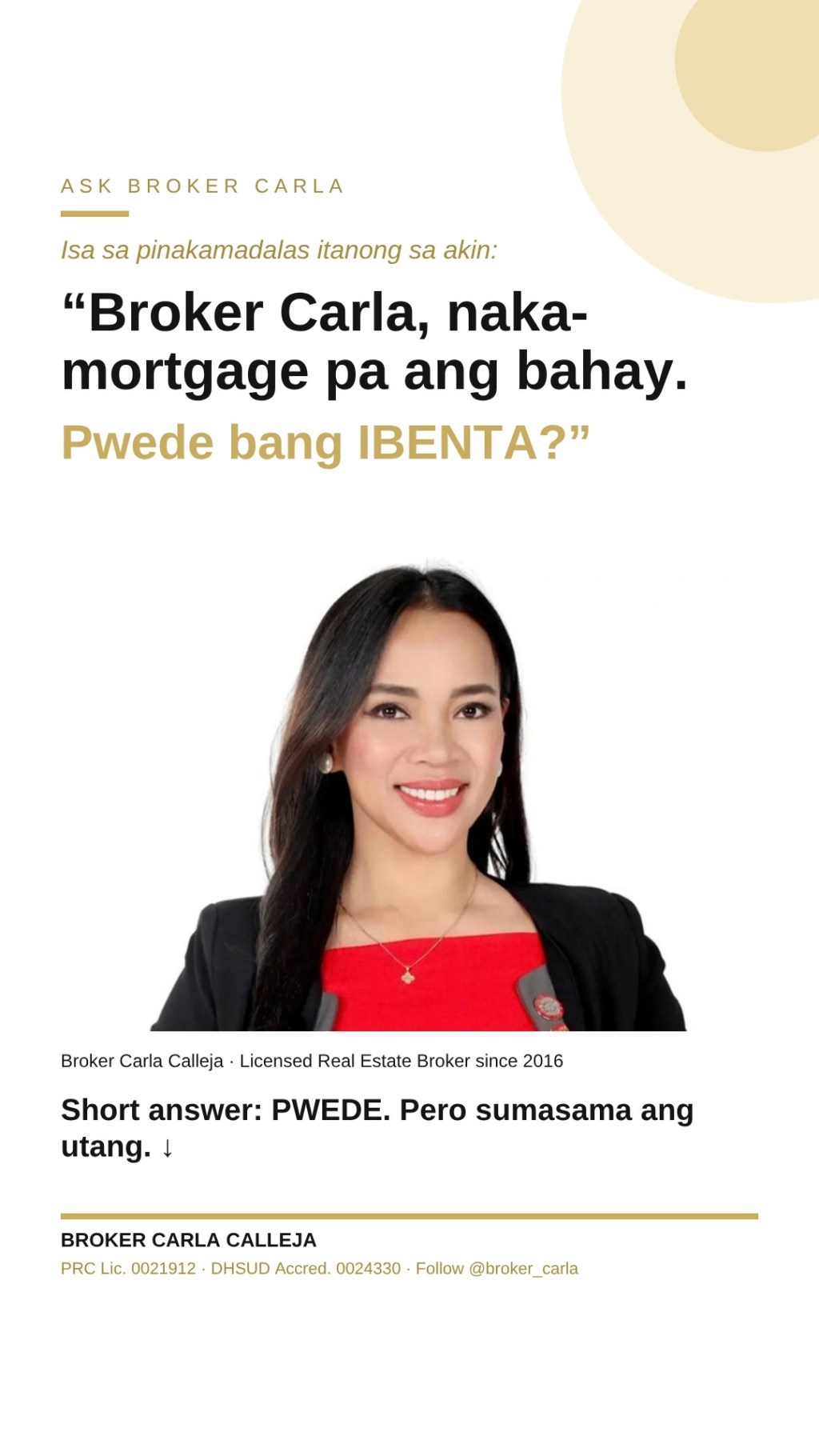
Isa sa pinakamadalas itanong sa akin: “Broker Carla, naka-mortgage pa ang bahay. Pwede bang ibenta?”
The story (a dramatization)
Mang Ben’s family is moving to Cebu for work. Their house in Bulacan still has a bank housing loan, and a buyer is ready to pay. One neighbor warns him: “Hindi mo maibebenta ‘yan hangga’t hindi bayad ang utang.” Another neighbor says the opposite: “Ibenta mo na lang. ‘Wag mo nang sabihin sa bangko.”
Pareho silang mali. Here’s why, and what Mang Ben should do instead.
The short answer
Yes, you can sell a mortgaged property. A mortgage does not take away your ownership. But the mortgage does not disappear when you sell. It stays attached to the property, whoever the new owner is, until the loan is paid and the mortgage is released. And your buyer does not automatically become the borrower. That needs the bank’s consent.
What the law says
- Civil Code, Article 2130: “A stipulation forbidding the owner from alienating the immovable mortgaged shall be void.” In plain words, a clause that flatly bans you from selling your mortgaged property has no effect.
- Civil Code, Article 2126: the mortgage “directly and immediately subjects the property upon which it is imposed, whoever the possessor may be.” The mortgage follows the property, not the person.
- Civil Code, Article 1293: substituting a new debtor for the old one cannot be done “without the consent of the creditor.” So the buyer can take over your loan only if the bank agrees.
What the Supreme Court said: Garcia v. Villar (2012)
In Pablo P. Garcia v. Yolanda Valdez Villar, G.R. No. 158891, June 27, 2012 (First Division), the owner of a house and lot in Quezon City mortgaged it to one lender in 1993, then to a second lender in 1994. Both mortgages were annotated on the title. In 1996 she sold the property to the first lender, and a new title was issued to the buyer, with both mortgages carried over to it.
The second lender sued, arguing that the buyer should pay the P1.8 million loan or face foreclosure. The Supreme Court ruled that:
- The sale was valid. Nothing in the mortgage deed stopped the owner from selling, and a clause like that “would have been void anyway” under Article 2130.
- The second mortgage survived the sale. The Court said a mortgage “is a real right, which follows the property, even after subsequent transfers by the mortgagor,” and the buyer must “acknowledge and respect the encumbrance.”
- But the buyer did not become liable for the seller’s loan. She had not agreed to replace the debtor, and she “could not do so in law without the creditor’s consent.” The lender’s remedy depended on the original borrowers defaulting after demand.
One detail worth knowing: the title annotation in that case said the mortgagee’s consent was needed for a later sale, but the Court looked at the mortgage deed itself, which had no such requirement. Bank loan contracts today often have their own terms on selling or transferring the property, so always read yours.
So why are both neighbors wrong?
“Hindi mo maibebenta” is wrong because the law allows the sale. “‘Wag mo nang sabihin sa bangko” is wrong because the mortgage stays on the title, any careful buyer will see it at the Registry of Deeds, and you remain the borrower until the loan is paid. Hiding it only invites a dispute with the buyer, the bank, or both.
Your 3 usual options
- Buyer’s payment pays off the loan. Part of the price goes straight to the bank, the bank issues a release of mortgage, and the rest goes to you. This is the cleanest route for most buyers.
- Buyer assumes the loan, with the bank’s written approval. The bank checks if the buyer qualifies. Without the bank’s consent, you stay liable.
- You pay off the loan first, then sell. Simple if you have the funds or bridge financing.
What this means for you: a 5-step checklist
- Ask the bank for a statement of account and the total payoff amount, with its validity date.
- Read your loan contract and talk to the bank before you sign anything with the buyer.
- Choose your route (payoff or assumption) and put it in writing in the Contract to Sell or Deed of Absolute Sale: who pays the bank, how much, and when.
- Once the loan is paid, get the release (cancellation) of mortgage and have it annotated on the title at the Registry of Deeds.
- Then file and pay the BIR taxes (6% capital gains tax under NIRC Sec. 24(D) and 1.5% documentary stamp tax under Sec. 196, both on the higher of the price or the BIR zonal or assessed value, for properties held as capital assets), get the eCAR, pay the local transfer tax and transfer the title.
Documents to prepare: owner’s copy of the title (often held by the bank), Certified True Copy from the Registry of Deeds, tax declaration and real property tax clearance, loan statement of account, the bank’s release of mortgage, and valid IDs of the parties.
FAQ
Can the bank stop me from selling?
A clause that simply forbids the sale is void under Article 2130. But the mortgage stays on the property, and your loan contract may have other terms on transfers, so coordinate with the bank first.
I’m the buyer. Is it safe to buy a mortgaged property?
It can be, if the loan is paid off as part of the deal and the release of mortgage is annotated before you pay the balance. Check the title at the Registry of Deeds yourself. If you buy without clearing it, the bank’s mortgage still binds the property.
Who holds the owner’s copy of the title?
Usually the bank, until the loan is paid. Ask the bank how and when it will release the title and the cancellation documents.
What if the property was inherited and is still mortgaged?
The estate must be settled first (extrajudicial settlement and estate tax), and the bank must still be paid or agree to the arrangement. See my guide on selling inherited property when a sibling won’t sign.
Ask Broker Carla
May tanong ka rin? Comment MORTGAGE on my latest post for this checklist, or send me your own “Broker Carla, …” question on my Facebook page, facebook.com/carlacallejabrokerphilippines, or by email at buyrentph@gmail.com.
Related reads: Can we sell land with only a tax declaration? · Our land was sold twice. Who owns it? · How to check a land title before you buy
This article is for general information only and is not legal or tax advice. For your specific situation, consult a lawyer or a licensed professional.
Sources
- Garcia v. Villar, G.R. No. 158891, June 27, 2012 (Supreme Court E-Library)
- Civil Code of the Philippines (RA 386), Arts. 1293, 2126, 2130 (Lawphil)
- National Internal Revenue Code, Secs. 24(D) and 196 (BIR)
ⓒ Broker CARLA CALLEJA · PRC License 0021912 · DHSUD Accred. No. 0024330

